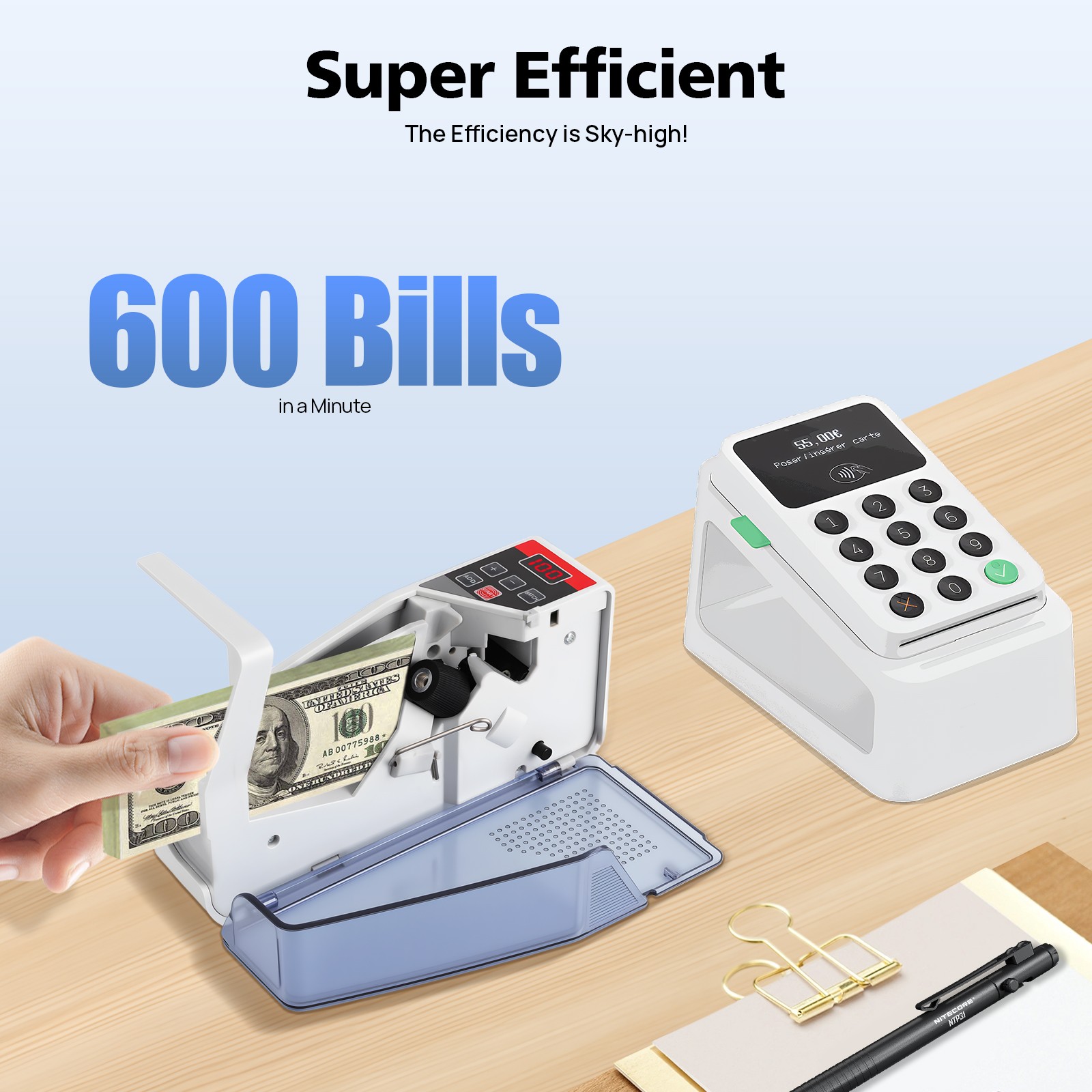

Photos from current listings. Actual item, color, and included accessories may vary.
Portable Cash Counting Machine Buying Guide
A portable cash counting machine is a compact, often battery-capable bill counter designed for mobile or temporary counting stations. The primary trade-off is between true portability (lightweight, battery power) and the speed, durability, and counterfeit-detection features of a full-size desktop unit. Choose a portable model only if you move the counter between locations; if it stays on one desk, a standard desktop counter delivers better throughput and value.
Key takeaways
- Counting speed: portable units typically run 600-1000 bills/min; desktop counters reach 1000-1900 bills/min, so volume per session dictates the tier.
- Counterfeit detection: portable models often include UV and magnetic (MG) sensors; full-size units add infrared (IR) and image scanning for higher-security cash handling.
- Power architecture: battery-powered portables use sealed lead-acid or lithium packs (often 4-6 hours runtime) with AC adapter; non-portable counters are AC-only.
At a glance
- Category
- Cash Handling & Mailroom
- Last updated
- Nov 29, 2026
Current offers
Highlights
- Counting speed: portable units typically run 600-1000 bills/min; desktop counters reach 1000-1900 bills/min, so volume per session dictates the tier.
- Counterfeit detection: portable models often include UV and magnetic (MG) sensors; full-size units add infrared (IR) and image scanning for higher-security cash handling.
- Power architecture: battery-powered portables use sealed lead-acid or lithium packs (often 4-6 hours runtime) with AC adapter; non-portable counters are AC-only.
- Hopper capacity: portables hold 100-200 bills in the hopper and stacker; desktop machines handle 300-500 bills per batch, reducing reload frequency.
Best use cases
- Best fit: mobile vendors, event cashiers, and field deposit prep — pick a battery-powered portable with UV/MG detection and a 100+ bill hopper.
- Wrong fit: high-volume retail back office counting 10,000+ bills daily — choose a desktop counter with 1000+ bills/min and IR detection instead.
- Best fit: small business with occasional cash — a compact AC/DC portable under 5 lb covers both counter and travel needs.
Buying tips
- Match counting speed to daily volume: under 2,000 bills/day, a 600-1000 bills/min portable suffices; above that, step up to a desktop model.
- Check hopper and stacker capacity: portable units with 100-bill hoppers need frequent reloading; 200-bill capacity cuts interruptions during batch counts.
- Confirm counterfeit sensors: UV alone catches paper fluorescence; MG detects magnetic ink on genuine US bills — both are minimum for portable cash handling.
- Verify battery runtime and charge time: look for at least 4 hours of continuous counting per charge and a replaceable battery pack for long-term serviceability.
Specs
| Counting Speed | 600-1000 bills/min (portable) |
|---|---|
| Counterfeit Detection | UV, UV+MG, or UV+MG+IR |
| Power Source | AC 110V + rechargeable battery |
| Hopper Capacity | 100-200 bills (portable) |
Related searches
What to check before buying
- Measure your counting surface: portable units need at least 12 x 10 inches of flat space and 10 inches of height clearance for the bill path.
- Confirm power: check whether the unit runs on 110V AC (US standard) and whether the battery is user-replaceable or sealed.
- Verify bill compatibility: ensure the counter handles the currency and denominations you process (e.g., US bills only vs. multi-currency).
- Plan for accessories: portable counters often need a carry case, spare battery, and cleaning cards — confirm these are included or available.
FAQ
Data sources: eBay / Amazon listings and product attribute feeds. Updated Nov 29, 2026.
Some links on this page are affiliate links. If you buy after clicking one, we may earn a commission at no extra cost to you. This does not change which products appear here or their order. Affiliate disclosure.