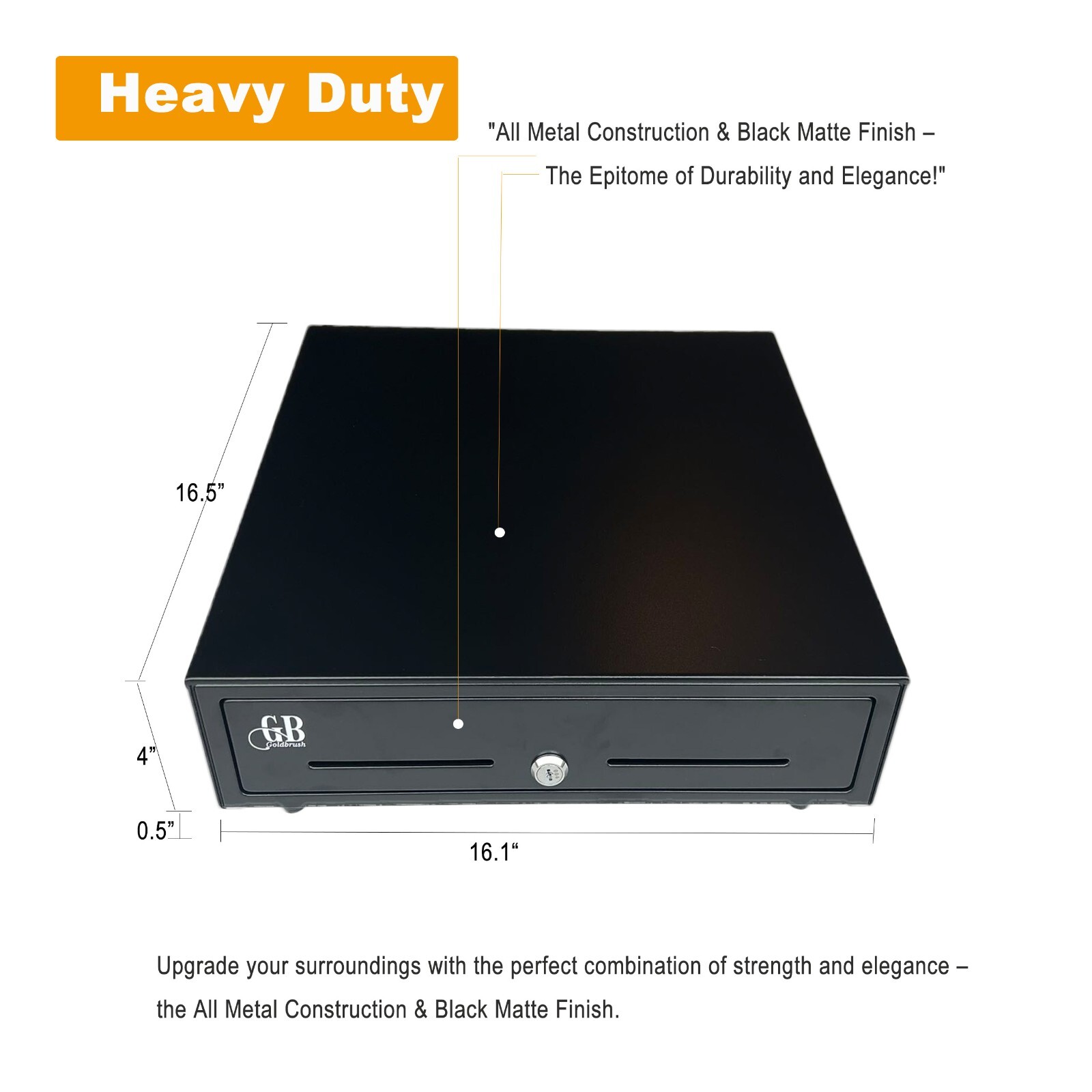

Photos from current listings. Actual item, color, and included accessories may vary.
Cash Register With Drawer Buying Guide
A cash register with drawer pairs a transaction terminal (electronic register or POS software hub) with a dedicated cash drawer that opens via receipt printer signal, manual key, or register solenoid. The core trade-off is drawer gauge and slide durability versus terminal architecture: integrated all-in-one registers simplify setup but lock you into one ecosystem, while printer-driven POS drawers scale across stations. Buy a steel-bodied drawer rated for daily solenoid cycles and match the terminal's open-signal standard (RJ11/RJ12 or 24V) to your printer or register before anything else.
Key takeaways
- Steel gauge drives durability: SPCC steel bodies resist prying and hold slide alignment; ABS trays cut weight but flex under repeated slams, so specify steel shell with removable ABS coin insert.
- Open-signal standard is the compatibility linchpin: most POS drawers trigger via 24V RJ11/RJ12 from a receipt printer, while standalone registers use proprietary solenoid wiring or manual key release.
- Bill/coin capacity tiers: 4-bill/5-coin trays suit low-volume cafés; 5-bill/5-coin layouts with removable compartments fit supermarkets and bars needing quick denomination swaps and rolled-coin storage.
At a glance
- Category
- Cash Handling & Mailroom
- Last updated
- Nov 29, 2026
Current offers
Highlights
- Steel gauge drives durability: SPCC steel bodies resist prying and hold slide alignment; ABS trays cut weight but flex under repeated slams, so specify steel shell with removable ABS coin insert.
- Open-signal standard is the compatibility linchpin: most POS drawers trigger via 24V RJ11/RJ12 from a receipt printer, while standalone registers use proprietary solenoid wiring or manual key release.
- Bill/coin capacity tiers: 4-bill/5-coin trays suit low-volume cafés; 5-bill/5-coin layouts with removable compartments fit supermarkets and bars needing quick denomination swaps and rolled-coin storage.
- Unlocking methods separate tiers: key-only drawers are cheapest but stall at shift changes; 3-way (solenoid, key, manual lever) drawers keep checkout moving during printer or power failures.
Best use cases
- Best fit: café or food truck running a tablet POS — pick a 13-16 inch steel drawer with RJ11/RJ12 cable and 4-bill/5-coin tray; skip multi-station drawers with bulky 5-bill till if counter depth is under 16 inches.
- Best fit: bar or restaurant with high cash turnover — choose 5-bill/5-coin removable-compartment drawer with 3-way unlocking so staff can open during printer jams; skip key-only economy drawers that bottleneck peak hours.
- Best fit: supermarket or multi-lane retail — pair a printer-driven drawer with an integrated register only if you need standalone operation; otherwise standardize on RJ12 drawers so any lane can swap hardware without retraining cashiers.
- Wrong fit: mobile pop-up stalls with no receipt printer — an RJ11 drawer has no trigger source, so buy a manual-key drawer or an all-in-one register with built-in drawer instead.
Buying tips
- Measure counter depth first: a 16-inch drawer needs 18+ inches of clearance for the slide and cable bend; 13-inch drawers fit compact counters but cap bill tray width at standard US notes.
- Match the open signal: confirm your receipt printer outputs 24V RJ11/RJ12 (most Epson and Star models do); a drawer without the matching connector needs a solenoid adapter or returns to sender.
- Specify steel over plastic for any drawer seeing more than a few hundred opens daily — SPCC steel shell with ball-bearing slides outlasts ABS by years of solenoid slams.
Specs
| Drawer Shell Material | SPCC steel vs ABS plastic |
|---|---|
| Open Signal | 24V RJ11/RJ12 vs manual key |
| Till Layout | 4-bill/5-coin vs 5-bill/5-coin |
| Unlock Methods | Solenoid + key + manual lever |
Related searches
What to check before buying
- Measure counter width and depth: 13-inch drawer needs ~15 inches clearance, 16-inch needs ~18 inches including cable radius.
- Confirm receipt printer or register open-signal voltage and connector (24V RJ11/RJ12 vs proprietary solenoid) before ordering.
- Verify till layout fits your currency: US 4-bill/5-coin is standard; check bill tray length for non-US note sizes.
- Plan for power loss: choose 3-way unlocking (solenoid + key + manual lever) if cash access must survive outages or printer failure.
FAQ
Data sources: eBay / Amazon listings and product attribute feeds. Updated Nov 29, 2026.
Some links on this page are affiliate links. If you buy after clicking one, we may earn a commission at no extra cost to you. This does not change which products appear here or their order. Affiliate disclosure.