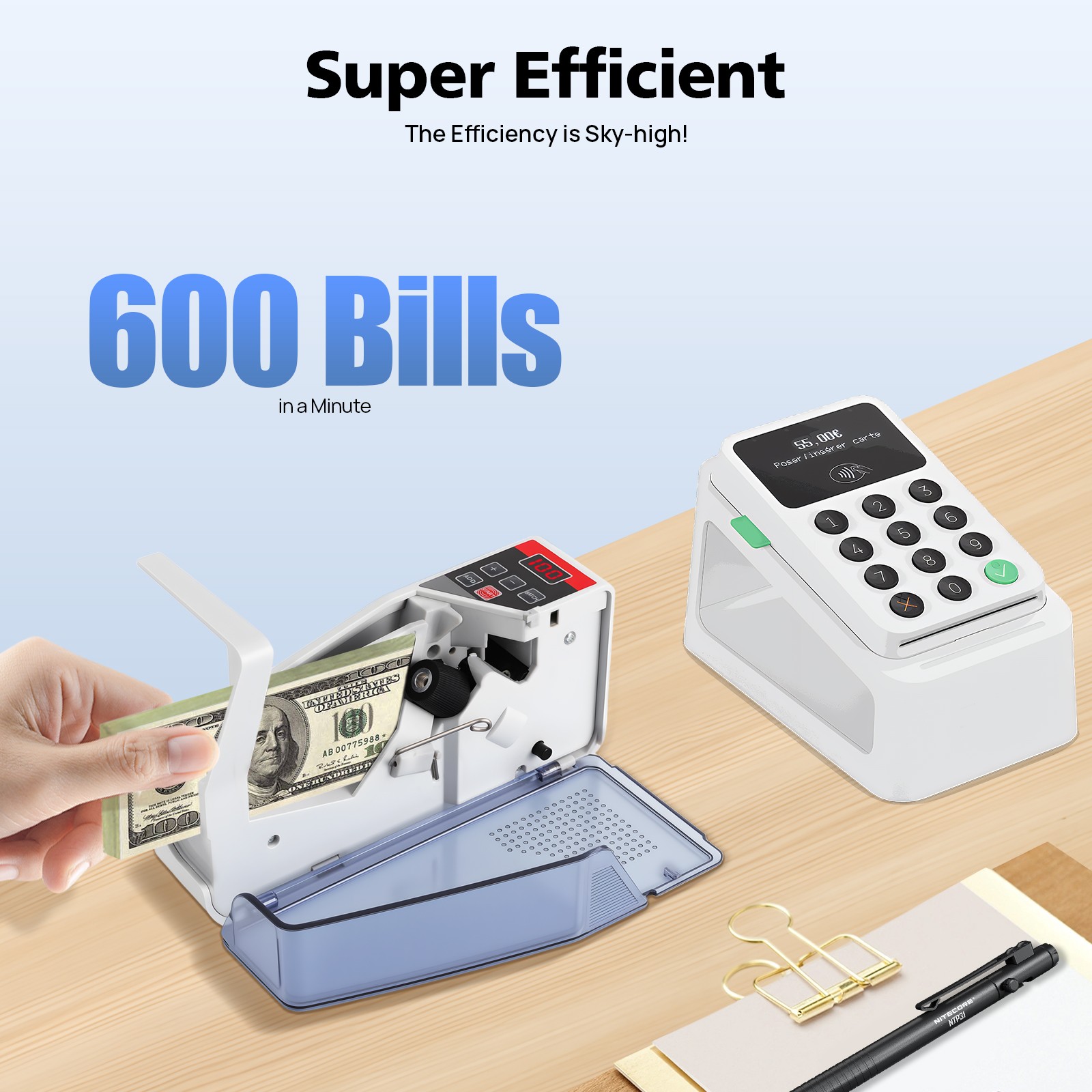

Photos from current listings. Actual item, color, and included accessories may vary.
Cash Counting Machine Buying Guide
A cash counting machine automates bill counting, counterfeit screening, and batch strapping for high-volume cash operations. The primary trade-off is between basic friction-fed counters with UV/MG sensors and value-counting machines with contact image sensors (CIS) that read mixed denominations and serial numbers. Choose a CIS value counter for mixed stacks and audit trails; a friction counter is adequate only for single-denomination, pre-sorted cash.
Key takeaways
- Friction roller feed handles 1,000–1,900 bills/min but jams on mixed denominations, while CIS-equipped value counters read each bill and count mixed stacks at 800–1,200 bills/min.
- Counterfeit detection tiers: UV (fluorescent strip), MG (magnetic ink), IR (infrared), and DB (dimensional/width) — CIS models add full-image capture, serial-number logging, and half-note/chain-note detection.
- Hopper capacity typically 200–500 bills and stacker capacity 200–300 bills; models with a 500+ bill hopper and external display suit high-volume teller lines and back-office batch counting.
At a glance
- Category
- Cash Handling & Mailroom
- Last updated
- Nov 29, 2026
Current offers
Highlights
- Friction roller feed handles 1,000–1,900 bills/min but jams on mixed denominations, while CIS-equipped value counters read each bill and count mixed stacks at 800–1,200 bills/min.
- Counterfeit detection tiers: UV (fluorescent strip), MG (magnetic ink), IR (infrared), and DB (dimensional/width) — CIS models add full-image capture, serial-number logging, and half-note/chain-note detection.
- Hopper capacity typically 200–500 bills and stacker capacity 200–300 bills; models with a 500+ bill hopper and external display suit high-volume teller lines and back-office batch counting.
- Add-on modules matter: thermal receipt printers for audit logs, external customer-facing displays, and strap/band dispensers turn a counter into a complete cash-room station.
Best use cases
- Retail POS and small business daily close: pick a compact friction counter with UV/MG detection for single-denomination till counts; skip CIS value counters unless you routinely accept mixed bills.
- Bank teller, check cashing, and casino cage: choose a CIS value counter with mixed-denomination reading, serial-number capture, and external display; friction counters cannot produce the audit trail regulators expect.
- Armored carrier, vault, and back-office batch processing: select a high-capacity friction or value counter with 500+ bill hopper, stacker, and strap dispenser for continuous 1,000+ bill runs; skip portable or battery models.
- Multi-currency exchange desks: require a value counter with multi-currency firmware and DB (dimensional) detection; single-currency friction counters will misclassify foreign bills and raise false rejects.
Buying tips
- Match counting technology to your cash mix: friction rollers for sorted single-denomination stacks, CIS value counters for mixed denominations — do not buy a friction counter expecting mixed-stack totals.
- Check counterfeit sensor stack: UV + MG + IR + DB is the minimum for fraud-prone retail; add CIS image capture when you need serial-number logs or half-note detection.
- Size hopper and stacker to your peak batch: a 200–300 bill hopper suits small retail closes, while 500+ bill hoppers prevent mid-batch stops in bank and vault operations.
- Confirm currency firmware and detection calibration for your country's bills; multi-currency support must be explicitly listed for each denomination you handle, not just USD.
Specs
| Counting Technology | Friction roller vs CIS value counter |
|---|---|
| Counterfeit Detection | UV / MG / IR / DB / CIS |
| Counting Speed | 800–1,900 bills/min by type |
| Hopper / Stacker | 200–500 / 200–300 bills |
Related searches
What to check before buying
- Measure your counting station: counters need roughly 12–18 inches of width and a stable, level surface; confirm the footprint and weight fit your teller window or back-office desk.
- Verify power: most counters run 110–240V with regional plug types; confirm the included cord and adapter match your outlet standard before ordering.
- Check companion parts: external displays, thermal printers, and strap dispensers are often sold separately — confirm which modules are included in the box.
- Plan for noise and debris: friction counters run 60–70 dB and generate paper dust; place the unit away from quiet customer areas and clean rollers and sensors regularly.
FAQ
Data sources: eBay / Amazon listings and product attribute feeds. Updated Nov 29, 2026.
Some links on this page are affiliate links. If you buy after clicking one, we may earn a commission at no extra cost to you. This does not change which products appear here or their order. Affiliate disclosure.