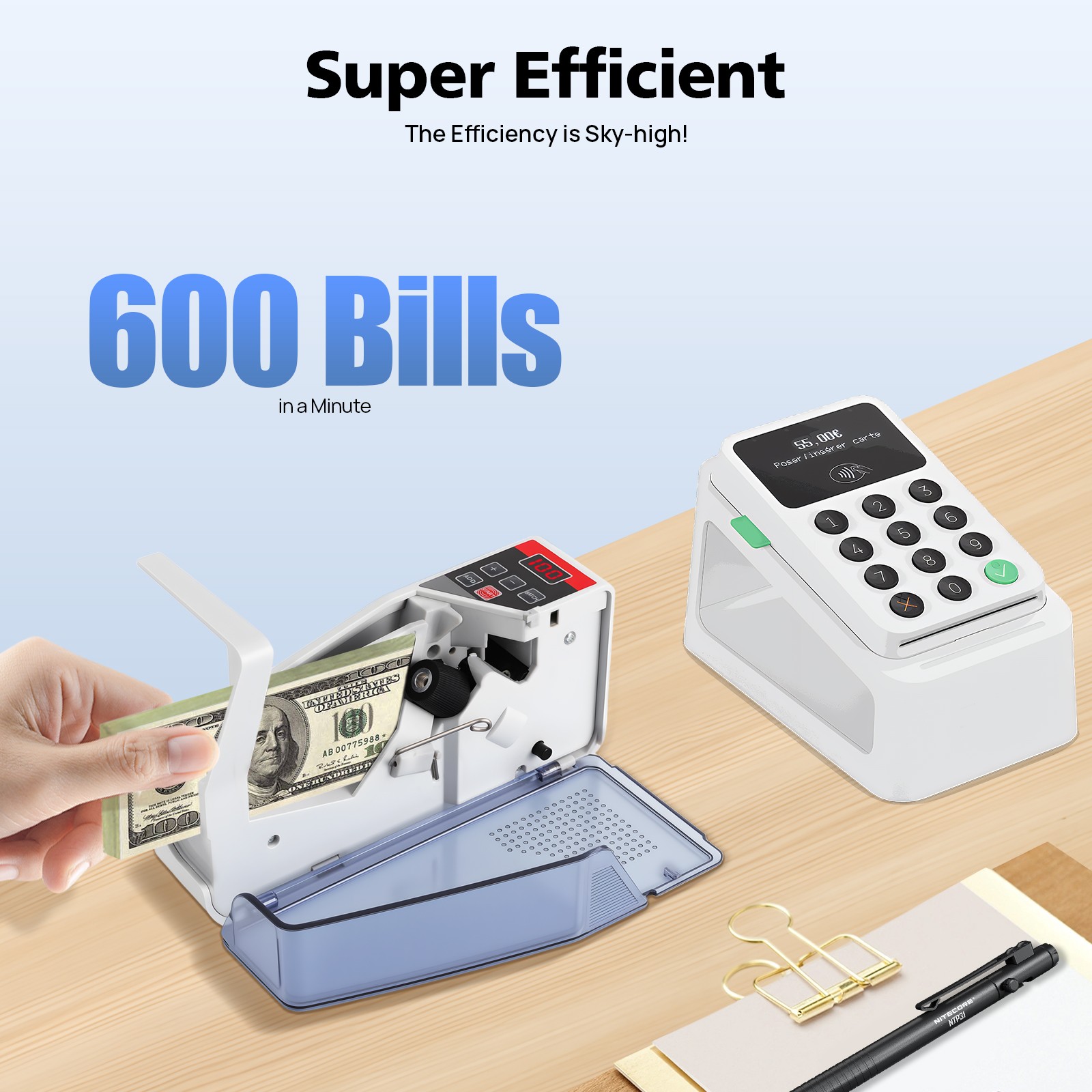

Photos from current listings. Actual item, color, and included accessories may vary.
Portable Cash Counter Buying Guide
A portable cash counter is a compact, often battery-powered machine that counts, batches, and sometimes authenticates banknotes or coins for mobile or small-space cash operations. The core trade-off is between friction-based value counting (fast, affordable, but unable to detect counterfeits) and sensor-equipped mixed-denomination counters (slower, pricier, but with UV/MG/IR verification and denomination sorting). The decision rule: buy a friction counter only for same-denomination bulk counting in low-fraud environments; buy a sensor counter with counterfeit detection and mixed-denomination recognition for any customer-facing or high-risk cash handling.
Key takeaways
- Counting technology splits into friction-roller value counters (single denomination, 600–1,500 notes/min) and mixed-denomination sensor counters (UV/MG/IR, 300–800 notes/min).
- Counterfeit detection tiers: UV (fluorescent ink) only is entry-level; MG (magnetic ink) adds security-thread verification; IR (infrared) validates paper composition and is the most reliable optical method.
- Portable units typically run on 4×AA batteries or a built-in rechargeable pack; AC adapter compatibility (100–240V, 50/60Hz) matters for international use.
At a glance
- Category
- Cash Handling & Mailroom
- Last updated
- Nov 29, 2026
Current offers
Highlights
- Counting technology splits into friction-roller value counters (single denomination, 600–1,500 notes/min) and mixed-denomination sensor counters (UV/MG/IR, 300–800 notes/min).
- Counterfeit detection tiers: UV (fluorescent ink) only is entry-level; MG (magnetic ink) adds security-thread verification; IR (infrared) validates paper composition and is the most reliable optical method.
- Portable units typically run on 4×AA batteries or a built-in rechargeable pack; AC adapter compatibility (100–240V, 50/60Hz) matters for international use.
- Hopper capacity on portable models ranges from 100 to 300 notes; stacker capacity 100–200 notes; note thickness adjustment (0.08–0.12mm) is manual on most portable units.
Best use cases
- Best fit: market vendors, food trucks, and small retail with single-currency, same-denomination bulk — choose a friction roller counter with UV detection and 4×AA power.
- Best fit: pawn shops, check-cashing, and mobile tax services handling mixed notes — choose a mixed-denomination sensor counter with UV+MG+IR and denomination sorting.
- Wrong fit: high-volume bank teller lines or casino cages — portable counters lack the 1,000+ note hoppers, continuous-duty motors, and networked audit logs of desktop commercial units.
Buying tips
- For same-denomination counting, friction counters at 600–1,000 notes/min are sufficient; pay more only for mixed-denomination recognition if you handle multiple note values per batch.
- Prioritize IR detection over UV alone if counterfeit risk is real; UV catches only fluorescent ink, while IR verifies paper and print layers.
- Check note thickness adjustment range (0.08–0.12mm) against your currency’s worn-note tolerance; manual thumbwheel adjustment is standard on portables.
- Confirm power: 4×AA alkalines give roughly 1–2 hours of intermittent use; a built-in rechargeable pack or 100–240V AC adapter is better for daily shifts.
Specs
| Counting Technology | Friction roller vs sensor (UV/MG/IR) |
|---|---|
| Denomination Mode | Single value vs mixed recognition |
| Speed Range | 300–1,500 notes/min |
| Power Source | 4×AA / rechargeable / 100–240V AC |
Related searches
What to check before buying
- Measure your counter space and note stack: portable units are typically 25–35cm wide and need 10cm clearance behind for the stacker.
- Verify your currency’s note size (length × width) fits the hopper and stacker guides; most portables accept 100–190mm length.
- Confirm your region’s plug standard (US Type A/B, EU Type C/F, UK Type G) and whether the included adapter is 100–240V.
- Check that the unit ships with a note thickness adjustment tool, cleaning brush, and spare friction rollers — wear parts determine lifespan.
FAQ
Data sources: eBay / Amazon listings and product attribute feeds. Updated Nov 29, 2026.
Some links on this page are affiliate links. If you buy after clicking one, we may earn a commission at no extra cost to you. This does not change which products appear here or their order. Affiliate disclosure.