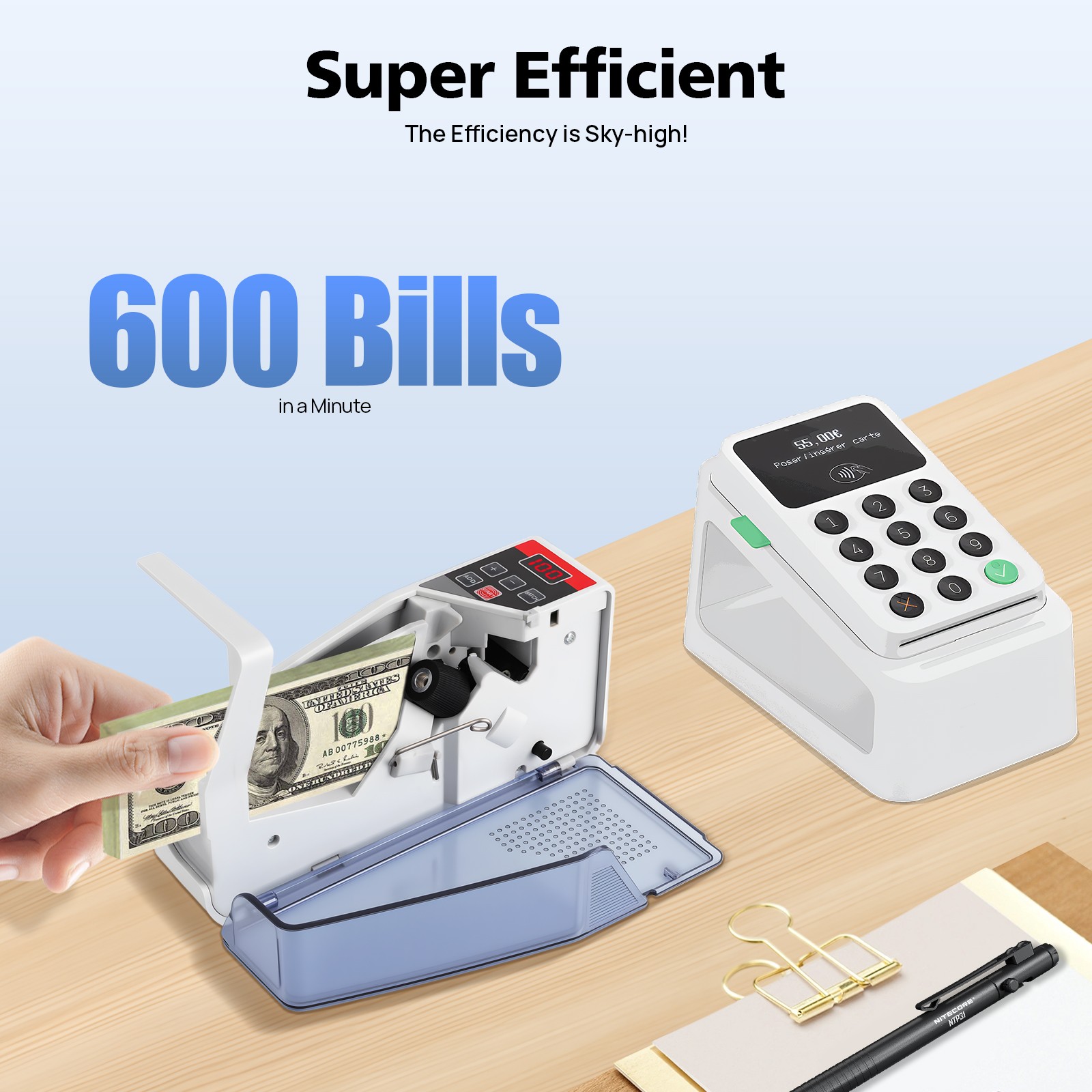

Photos from current listings. Actual item, color, and included accessories may vary.
Money Counting Machine Buying Guide
A money counting machine automates bill counting, counterfeit detection, and denomination sorting, with the core trade-off being basic counting speed versus advanced mixed-denomination value reading via CIS sensors. Choose a value-counting model with CIS if you handle mixed currency; choose a simple bill counter if you only need fast, single-denomination counting and basic UV/MG checks.
Median $217.95
Key takeaways
- CIS (Contact Image Sensor) enables mixed-denomination value counting and serial number capture; UV/MG/IR sensors only detect counterfeits on single-denomination stacks.
- Counting speed ranges from 1,000 to 1,900 bills per minute; higher speeds require robust friction rollers and a larger hopper capacity to avoid jams.
- Counterfeit detection tiers: UV (ultraviolet) catches paper fluorescence, MG (magnetic) reads ink properties, IR (infrared) checks paper density, and DBL/HLF detect double or half notes.
At a glance
- Category
- Cash Handling & Mailroom
- Last updated
- Nov 29, 2026
Current offers
Highlights
- CIS (Contact Image Sensor) enables mixed-denomination value counting and serial number capture; UV/MG/IR sensors only detect counterfeits on single-denomination stacks.
- Counting speed ranges from 1,000 to 1,900 bills per minute; higher speeds require robust friction rollers and a larger hopper capacity to avoid jams.
- Counterfeit detection tiers: UV (ultraviolet) catches paper fluorescence, MG (magnetic) reads ink properties, IR (infrared) checks paper density, and DBL/HLF detect double or half notes.
- Hopper capacity typically 200–500 bills; stacker capacity 200–300 bills — larger hoppers reduce reload frequency but increase footprint.
Best use cases
- Best fit: Retail cash offices and small businesses counting single-denomination daily takings — pick a UV/MG bill counter with 1,000+ bills/min and 200-bill hopper.
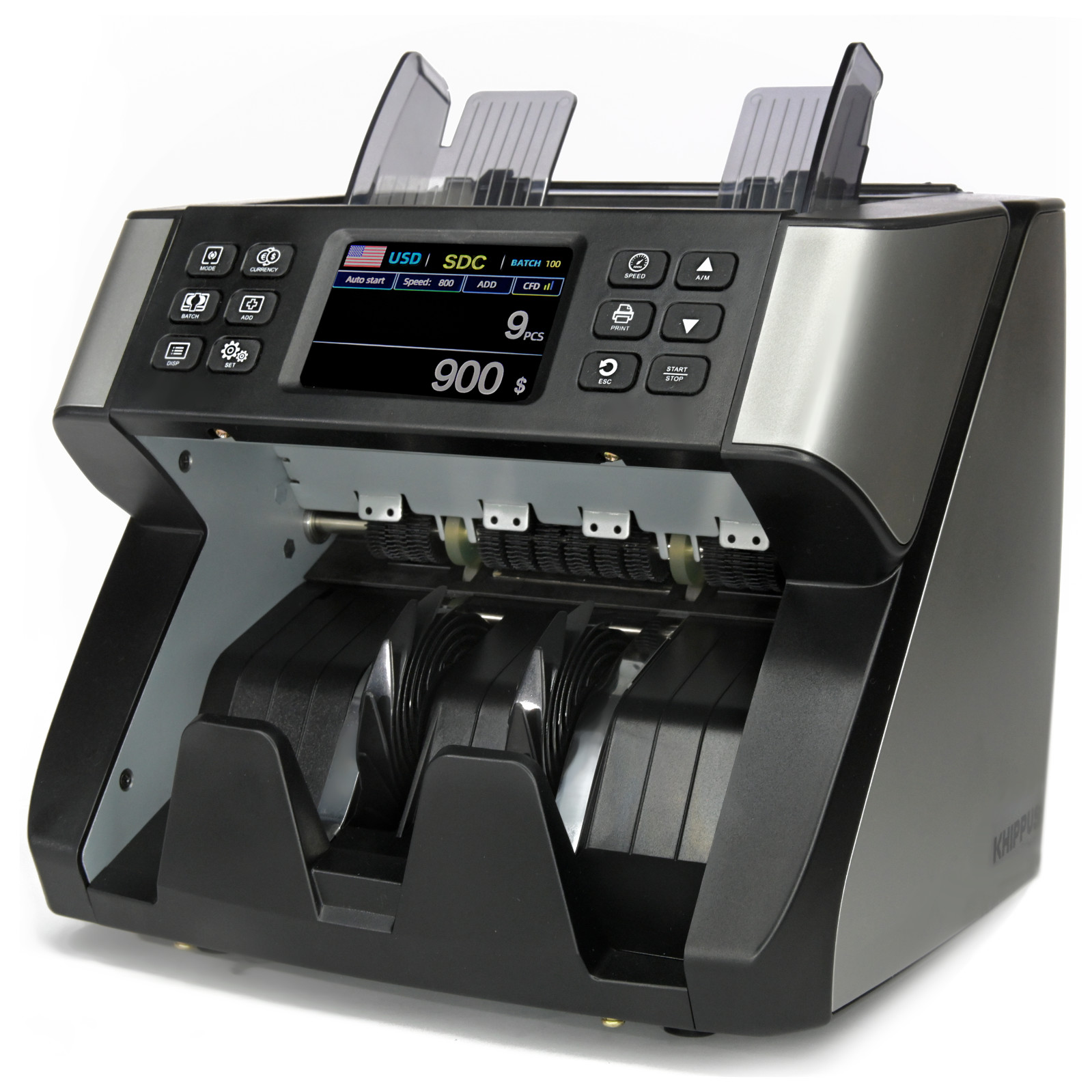
- Best fit: Check cashing, gaming, or multi-currency environments — choose a CIS mixed-denomination value counter with external display and multi-currency support.
- Wrong fit: High-volume bank vaults needing 1,900+ bills/min and continuous-duty motors — skip plastic-bodied consumer counters and step up to commercial-grade units with metal chassis.
- Skip CIS value counting if you only process single-denomination straps; a basic UV/MG counter saves cost and reduces calibration complexity.
Buying tips
- Match counting speed to volume: under 5,000 bills/day needs 1,000–1,300 bills/min; above that, select 1,500+ bills/min with a 300+ bill hopper.
- Require at least UV, MG, and IR counterfeit detection; add CIS only if you need mixed-denomination value totals or serial number logging.
- Check hopper and stacker capacity against your batch size — a 200-bill hopper means reloading every 200 notes, which slows high-volume workflows.
- Confirm voltage and plug standard (110V US vs 220V EU) and that the unit supports your currency's denomination set for accurate value counting.
Specs
| Counting Speed | 1,000–1,900 bills/min |
|---|---|
| Detection Sensors | UV / MG / IR / CIS |
| Hopper Capacity | 200–500 bills |
| Denomination Mode | Single or mixed via CIS |
Related searches
What to check before buying
- Measure your counter space: typical units are 10–14 inches wide and 9–12 inches deep; allow clearance for the external display and bill stacker.
- Verify your currency: CIS value counters must list your specific currency (USD, EUR, etc.) for denomination recognition and counterfeit templates.
- Confirm power: 110V/60Hz for US outlets; check that the included adapter matches your wall standard without a converter.
- Ensure you have a stable, level surface — vibration from high-speed rollers can cause misreads and jams on uneven counters.
FAQ
Data sources: eBay / Amazon listings and product attribute feeds. Updated Nov 29, 2026.
Some links on this page are affiliate links. If you buy after clicking one, we may earn a commission at no extra cost to you. This does not change which products appear here or their order. Affiliate disclosure.