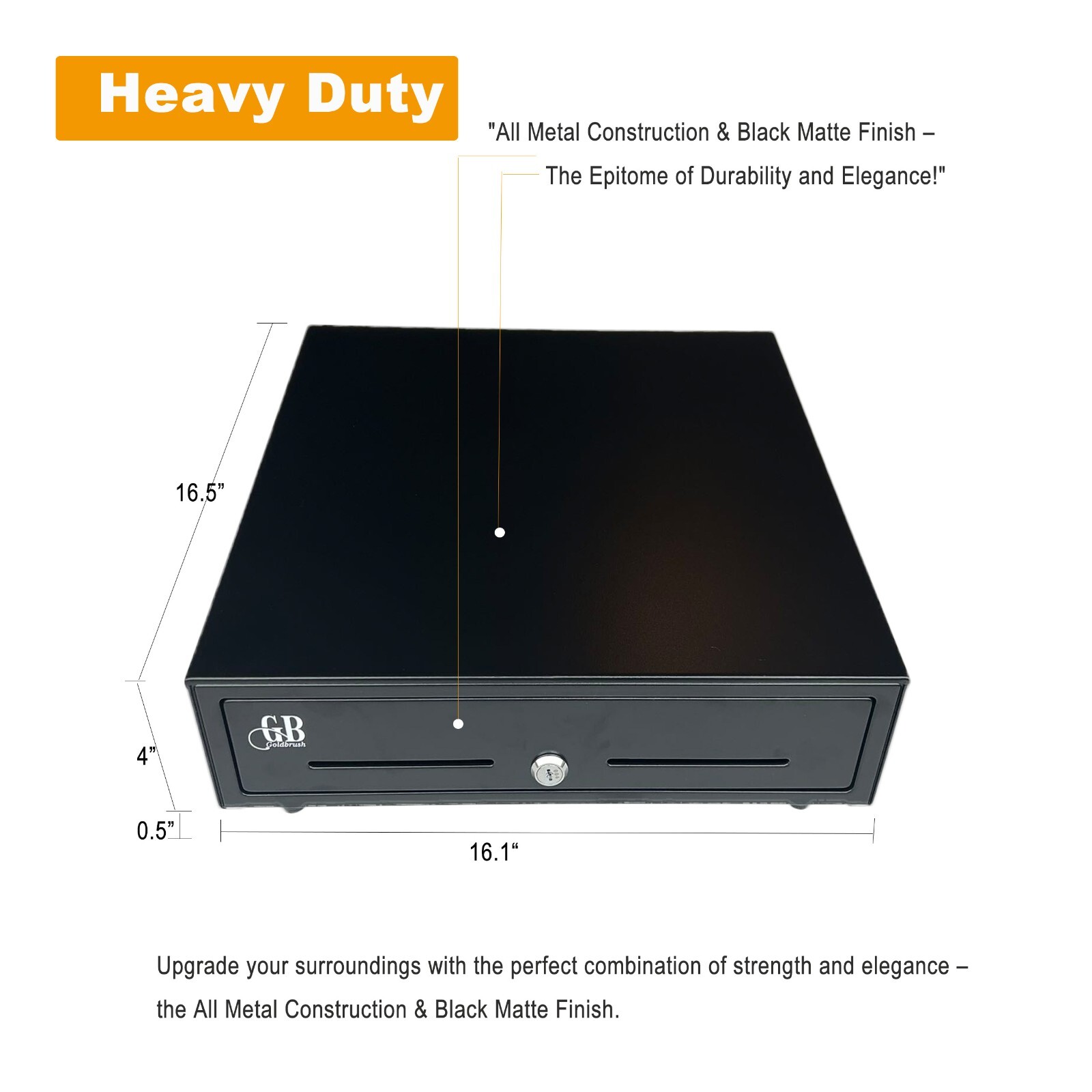

Photos from current listings. Actual item, color, and included accessories may vary.
Cash Register Buying Guide
A cash register is a transaction terminal combining a cash drawer, receipt printer, and payment interface for retail and hospitality. The core trade-off is standalone electronic register vs. POS-driven drawer: standalone units print receipts and work without a computer but lock you into proprietary software, while USB/serial drawers paired with a POS app cost less per lane but require a host device. Buy a standalone register only if you need offline operation; buy a drawer-only unit only if you already run POS software.
Key takeaways
- Drawer steel gauge: SPCC cold-rolled steel bodies in 0.7–1.0 mm resist pry and daily slam cycles; ABS front panels only on light-duty mini units.
- Bill/coin capacity: standard 5-bill/5-coin (or 5-bill/8-coin) trays fit full-size currency; 4-bill mini trays force folding and slow checkout.
- Interface: USB or serial (RJ11/RJ12) drawers trigger via printer kick-out or POS command; manual-key and solenoid releases are the fallback.
At a glance
- Category
- Cash Handling & Mailroom
- Last updated
- Nov 29, 2026
Current offers
Highlights
- Drawer steel gauge: SPCC cold-rolled steel bodies in 0.7–1.0 mm resist pry and daily slam cycles; ABS front panels only on light-duty mini units.
- Bill/coin capacity: standard 5-bill/5-coin (or 5-bill/8-coin) trays fit full-size currency; 4-bill mini trays force folding and slow checkout.
- Interface: USB or serial (RJ11/RJ12) drawers trigger via printer kick-out or POS command; manual-key and solenoid releases are the fallback.
- Standalone registers bundle thermal receipt printers with proprietary firmware; POS drawers are dumb peripherals needing a host PC or tablet.
Best use cases
- Best fit: a single-lane shop or market stall with no computer — pick a standalone electronic register with built-in thermal printer and 5-bill/5-coin drawer.
- Best fit: a retail counter already running POS software on a tablet or PC — pick a USB/serial cash drawer sized 16" wide to match the counter and printer kick-out voltage.
- Wrong fit: high-volume multi-lane retail — skip mini 4-bill drawers and standalone registers; use a full 18" drawer with a POS terminal and cash-counting workflow.
- Wrong fit: mobile or pop-up selling — skip AC-powered registers and heavy steel drawers; use a tablet POS with a compact lockable cash box.
Buying tips
- Measure counter depth first: a 16" drawer needs at least 17" of clear depth for cable and kick-out clearance; 18" drawers need 19".
- Match drawer release voltage: 12V/24V solenoid drawers must match the printer or POS terminal kick-out port, or the drawer will not open.
- Choose bill/coin layout by currency: 5-bill/5-coin trays suit US bills; markets with high coin volume need 8-coin trays to avoid jams.
- For standalone registers, confirm thermal paper width (typically 57 mm or 80 mm) and that receipt rolls are standard, not proprietary cartridges.
Specs
| Type | Standalone register vs POS cash drawer |
|---|---|
| Drawer Size | 16 in vs 18 in wide |
| Bill/Coin Layout | 5-bill/5-coin vs 4-bill mini |
| Interface | USB / RJ11-RJ12 kick-out / manual key |
Related searches
What to check before buying
- Counter footprint: confirm at least 16" width and 17" depth clear for a 16" drawer, plus 2" rear clearance for cables and kick-out.
- Power: standalone registers need a nearby AC outlet; USB drawers draw power from the host or a 12V adapter — plan outlet and cable routing.
- Host compatibility: verify your POS software and printer support the drawer's USB or RJ11/RJ12 kick-out standard before buying a drawer-only unit.
- Currency fit: check that bill compartments match your note dimensions and coin cups match your coin denominations; mini trays may not fit all notes unfolded.
FAQ
Data sources: eBay / Amazon listings and product attribute feeds. Updated Nov 29, 2026.
Some links on this page are affiliate links. If you buy after clicking one, we may earn a commission at no extra cost to you. This does not change which products appear here or their order. Affiliate disclosure.