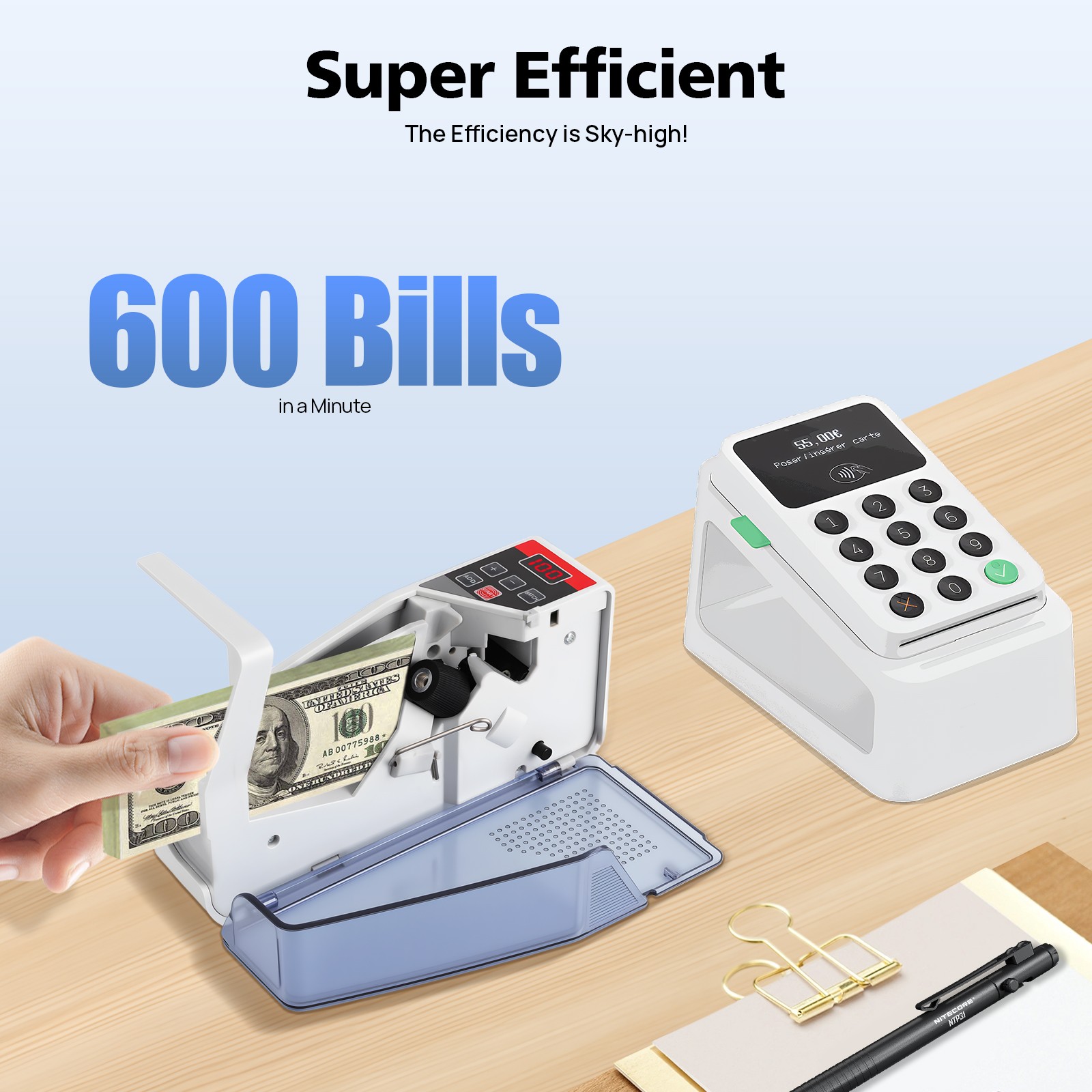

Photos from current listings. Actual item, color, and included accessories may vary.
Cash Counter Buying Guide
Cash counters are bill-counting machines that use friction rollers to feed notes past optical and magnetic sensors, grading from basic count-only units to mixed-denomination value counters with counterfeit detection. The core trade-off is bill-feed reliability and sensor suite depth versus the cost of the machine: cheap friction feeders misfeed worn or curled notes, while CIS-based value counters read and total mixed stacks without pre-sorting. Buy a note-value counter with CIS imaging and UV/MG/IR detection if you handle mixed cash daily; buy a count-only friction unit only for uniform, sorted bundles.
Key takeaways
- Feed mechanism: friction-roller front-load feeders handle 500-1500 notes/min but misfeed curled or taped bills; back-load or hopper-feed designs reduce jams on worn currency.
- Sensor suite tiers: basic units detect UV and magnetic (MG) ink; mid-tier adds infrared (IR) and dimensional (DD) checks; top-tier adds contact image sensor (CIS) for full-note imaging and mixed-denomination value totaling.
- Counterfeit detection methods: UV checks paper fluorescence, MG reads magnetic ink on genuine notes, IR verifies note length and print patterns, DD/DBL flags doubles and half-notes, HLF/CHN detect chained or half bills.
At a glance
- Category
- Cash Handling & Mailroom
- Last updated
- Nov 29, 2026
Current offers
Highlights
- Feed mechanism: friction-roller front-load feeders handle 500-1500 notes/min but misfeed curled or taped bills; back-load or hopper-feed designs reduce jams on worn currency.
- Sensor suite tiers: basic units detect UV and magnetic (MG) ink; mid-tier adds infrared (IR) and dimensional (DD) checks; top-tier adds contact image sensor (CIS) for full-note imaging and mixed-denomination value totaling.
- Counterfeit detection methods: UV checks paper fluorescence, MG reads magnetic ink on genuine notes, IR verifies note length and print patterns, DD/DBL flags doubles and half-notes, HLF/CHN detect chained or half bills.
- Mixed-denomination value counting requires CIS imaging plus denomination database firmware; count-only machines sort by size or just count and cannot total mixed stacks by value.
Best use cases
- Choose a CIS mixed-denomination value counter if you run a retail till, market stall, or small business and need a per-denomination breakdown and total from unsorted stacks.
- Choose a UV/MG count-only friction counter if you receive pre-sorted, uniform bundles from a bank or armored car and only need batch counts.
- Skip count-only units for heavily worn, curled, or taped notes—friction feed jams and misreads; step up to a back-load or hopper-fed model with IR/DD sensors.
- Skip high-end CIS models for single-currency, low-volume home use—basic UV/MG detection covers occasional sorting and counterfeit checks.
Buying tips
- Match sensor suite to workflow: UV+MG for count-only sorted bills; add IR and DD/DBL for worn notes; require CIS if you need mixed-denomination value totals.
- Check feed type against note condition: front-load friction rollers suit crisp, new bills; back-load or top-load hopper designs tolerate curled and circulated notes better.
- Confirm currency support and firmware updates—mixed-denomination value counting requires a denomination database for your specific currency (USD, EUR, GBP) and update path.
- Verify throughput and hopper capacity: entry units run roughly 500-1000 notes/min with 100-200 note hoppers; higher-volume units run 1000-1500 notes/min with larger hoppers.
Specs
| Counting Mode | Count-only vs mixed-denomination value |
|---|---|
| Sensor Suite | UV / MG / IR / DD / CIS imaging |
| Feed Type | Front-load friction vs back-load hopper |
| Throughput | 500-1500 notes/min, 100-200 note hopper |
Related searches
What to check before buying
- Confirm the machine supports your country's currency and firmware—mixed-value counting is currency-specific and cannot be assumed.
- Measure counter footprint and stack height against your counter space; hopper and stacker extensions need clearance in front and behind.
- Check power standard: most counters run 100-240V with regional plug types; confirm the included adapter matches your outlet.
- Verify note condition in your workflow—worn, taped, or curled bills may need a back-load/hopper model rather than a front-load friction feeder.
FAQ
Data sources: eBay / Amazon listings and product attribute feeds. Updated Nov 29, 2026.
Some links on this page are affiliate links. If you buy after clicking one, we may earn a commission at no extra cost to you. This does not change which products appear here or their order. Affiliate disclosure.