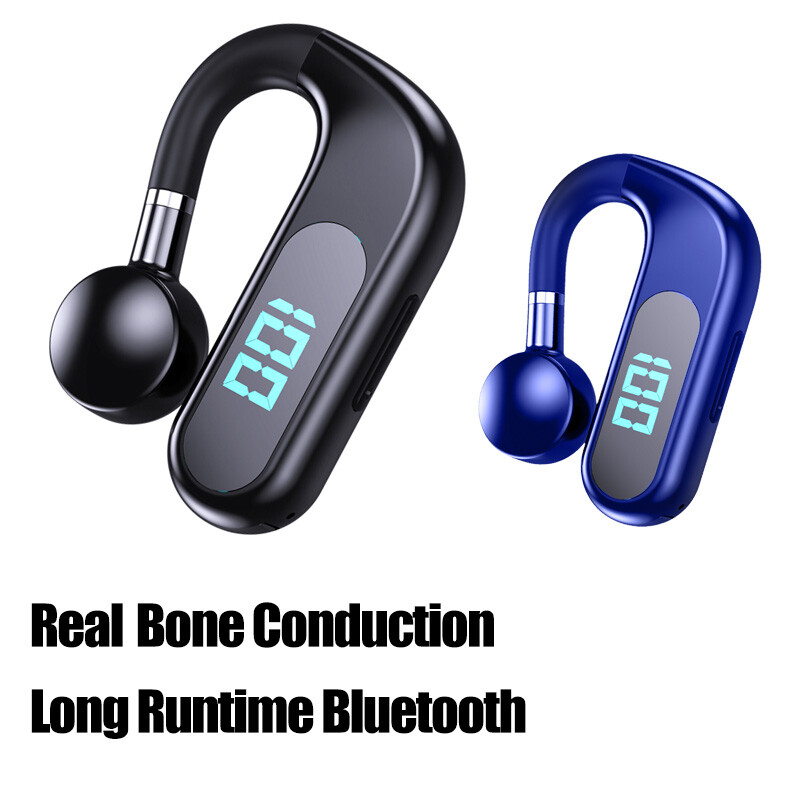

Photos from current listings. Actual item, color, and included accessories may vary.
Bone Conduction Headphone Buying Guide
Bone conduction headphones transmit sound via skull vibrations, leaving the ear canal open for situational awareness—ideal for cycling, trucking, and office use. The core trade-off is between secure open-ear fit and bass output: premium models use titanium bands and dual transducers for fuller sound, while budget units suffer leakage and weak low-end. The decision rule: buy IP67+ sweatproof with Bluetooth 5.2+ and a rigid memory-wire band for sport; skip any listing without a stated Bluetooth version or waterproof rating.
Key takeaways
- Transducer architecture: dual bone-conduction drivers vs single; dual units deliver fuller mid-bass and less vibration tickle at high volume.
- Bluetooth generation: 5.2/5.3 cuts latency and power draw versus 5.0; 5.0 is the minimum for stable multipoint on budget models.
- Ingress rating: IP67 survives sweat and rain; IPX5 is splash-only and fails in heavy rain or heavy perspiration over time.
At a glance
- Category
- Business Phones & Headsets
- Last updated
- Nov 29, 2026
Current offers
Highlights
- Transducer architecture: dual bone-conduction drivers vs single; dual units deliver fuller mid-bass and less vibration tickle at high volume.
- Bluetooth generation: 5.2/5.3 cuts latency and power draw versus 5.0; 5.0 is the minimum for stable multipoint on budget models.
- Ingress rating: IP67 survives sweat and rain; IPX5 is splash-only and fails in heavy rain or heavy perspiration over time.
- Battery tier: 8-10 hours is standard for sport; 30-hour class requires a larger rear band battery and is heavier for all-day wear.
Best use cases
- Cycling and running: pick IP67, 8-10 hr battery, Bluetooth 5.2+, and a flexible titanium band that stays put under a helmet—skip over-ear cups.
- Trucking and long shifts: choose the 30-hour rear-band battery tier with dual mics for calls; skip lightweight sport units that die mid-shift.
- Office and open-plan: select models with a physical mute button and low leakage at 60% volume; skip bass-heavy single-transducer units that leak sound.
- Swimming: bone conduction is not waterproof for submersion—choose IPX8 only if rated for swimming; otherwise skip and use dedicated swim MP3 players.
Buying tips
- Measure head circumference and temple width: band models fit 13-15 cm temple-to-temple; too-wide bands slip during runs, too-narrow bands clamp.
- Match Bluetooth version to your phone: 5.2+ supports LE Audio and multipoint; 5.0 models drop connection when switching between laptop and phone.
- For calls, require dual-mic noise cancellation (cVc 8.0 or equivalent); single-mic units fail in wind and traffic noise.
- Battery math: 8 hr at 70% volume is real-world for sport units; a 30-hr claim implies lower volume and larger rear battery—accept added weight.
Specs
| Transducer | Single vs dual bone-conduction |
|---|---|
| Bluetooth | 5.0 vs 5.2/5.3 multipoint |
| Waterproof | IPX5 splash vs IP67 sweat/rain |
| Battery Tier | 8-10 hr sport vs 30 hr rear-band |
Related searches
What to check before buying
- Temple-to-temple width of 13-15 cm suits most bands; measure before ordering to avoid slip or clamp.
- Confirm IP rating matches your activity: IP67 for sweat/rain, IPX8 only for pool swimming.
- Check Bluetooth 5.2+ for multipoint and low latency; 5.0 is acceptable only for single-device use.
- Verify your phone or laptop supports the codec (SBC/AAC standard; aptX/LDAC rare on bone conduction).
FAQ
Data sources: eBay / Amazon listings and product attribute feeds. Updated Nov 29, 2026.
Some links on this page are affiliate links. If you buy after clicking one, we may earn a commission at no extra cost to you. This does not change which products appear here or their order. Affiliate disclosure.