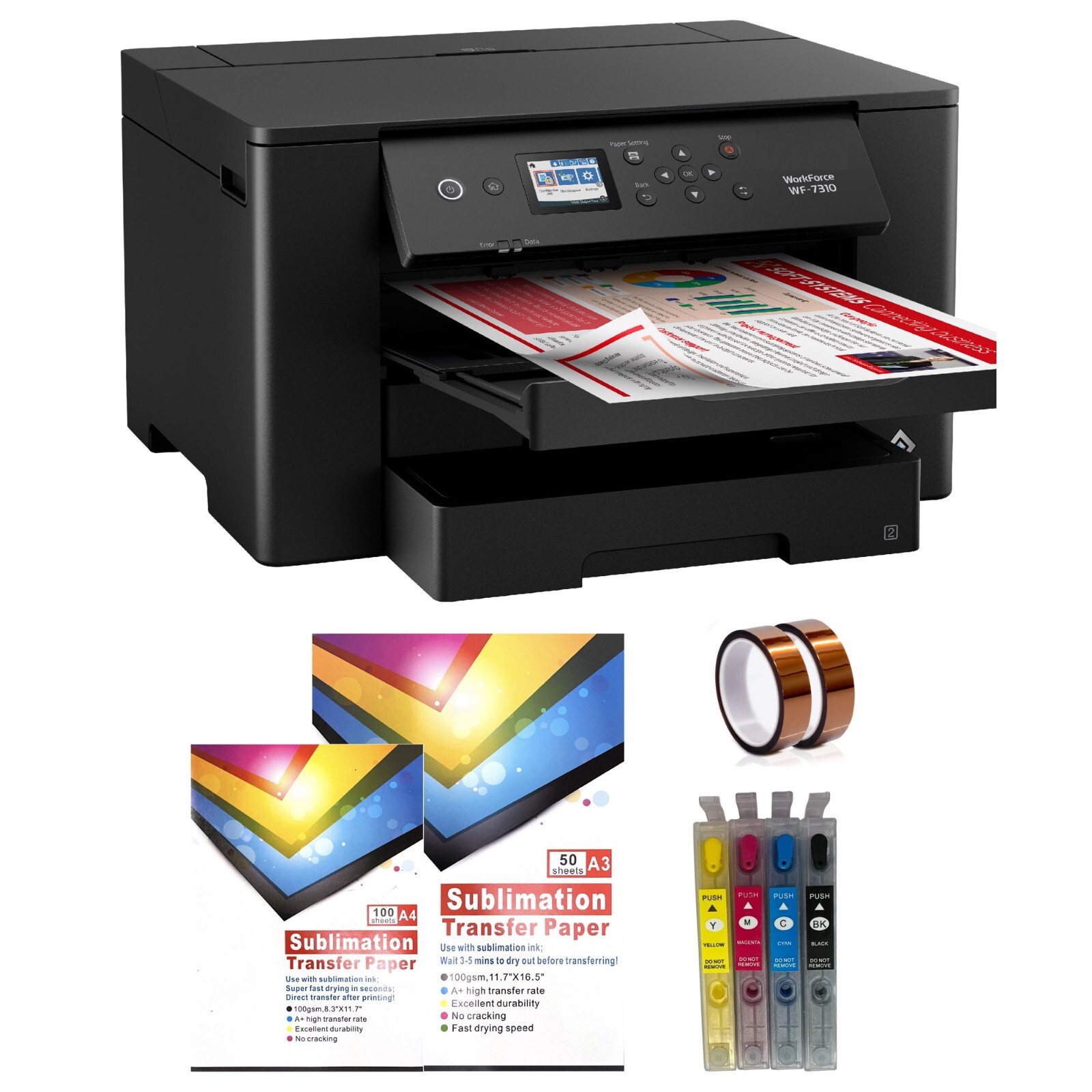

Photos from current listings. Actual item, color, and included accessories may vary.
Sublimation Printer Buying Guide
Sublimation printers are dye-sub inkjet systems (or converted desktop inkjets) that print mirror-image transfers for polyester fabrics and polymer-coated hard goods. The core trade-off is A4 vs A3+ carriage width and OEM vs converted printhead durability, since sublimation ink voids most warranties. Choose a factory-built A3+ sublimation unit for daily shirt/tumbler volume; pick a warranted A4 converted desktop only for low-output hobby work.
Key takeaways
- A3+ (13x19 in) carriage handles full shirt fronts and tumbler wrap sheets in one pass; A4 (8.5x11.7 in) forces tile-and-seam workflows.
- Purpose-built sublimation printers ship with ICC profiles and waste-ink handling; converted Epson EcoTank units need manual profile tuning and void the warranty.
- Micro Piezo printheads (Epson) tolerate glycol-based sublimation ink better than thermal bubble heads, which clog and fail under dye-sub chemistry.
At a glance
- Category
- Wide-Format Printers & Plotters
- Last updated
- Nov 23, 2026
Current offers
Highlights
- A3+ (13x19 in) carriage handles full shirt fronts and tumbler wrap sheets in one pass; A4 (8.5x11.7 in) forces tile-and-seam workflows.
- Purpose-built sublimation printers ship with ICC profiles and waste-ink handling; converted Epson EcoTank units need manual profile tuning and void the warranty.
- Micro Piezo printheads (Epson) tolerate glycol-based sublimation ink better than thermal bubble heads, which clog and fail under dye-sub chemistry.
- Four-color CMYK dye-sub yields vivid polyester output but cannot hit true fluorescent or metallic tones without specialty ink sets and matching ICC profiles.
Best use cases
- Pick an A3+ purpose-built sublimation printer for daily shirt and tumbler production: it prints full fronts and 20 oz tumbler wraps without seams.
- Choose a warranted A4 converted EcoTank desktop for occasional shirts and mugs under low monthly volume, accepting manual color profiling.
- Skip A4 units entirely if you sell all-over apparel or 20 oz tumblers at volume; the seam alignment and reprint rate erase the hardware savings.
Buying tips
- Match carriage width to substrate: A3+ (13x19 in) for full shirt fronts and tumbler wraps; A4 only for pocket logos and small mugs.
- Buy a factory sublimation model to keep the warranty; converted EcoTank printers void coverage the moment dye-sub ink enters the head.
- Verify the bundled ICC profile matches your exact ink set and paper GSM, since generic profiles cause dull or oversaturated transfers.
- Budget for a heat press (385-400 F) alongside the printer; the printer only produces transfer sheets, not finished garments.
Specs
| Carriage Width | A3+ 13x19 in vs A4 8.5x11.7 in |
|---|---|
| Printhead Type | Micro Piezo vs thermal bubble |
| Ink Chemistry | Dye-sub CMYK vs pigment/DTF |
| Warranty Status | Factory-covered vs voided conversion |
Related searches
What to check before buying
- Measure your heat press platen before choosing carriage width: an A3+ print needs a 15x15 in or larger press to transfer in one pass.
- Confirm 110V/60Hz input and standard NEMA 5-15 plug compatibility for your workspace circuit.
- Check that the ink set is a true dye-sub formulation (not pigment or DTF) and that ICC profiles are supplied for your paper GSM.
- Verify your garments are at least 65% polyester and hard goods carry a polymer sublimation coating before buying any printer tier.
FAQ
Data sources: eBay / Amazon listings and product attribute feeds. Updated Nov 23, 2026.
Some links on this page are affiliate links. If you buy after clicking one, we may earn a commission at no extra cost to you. This does not change which products appear here or their order. Affiliate disclosure.