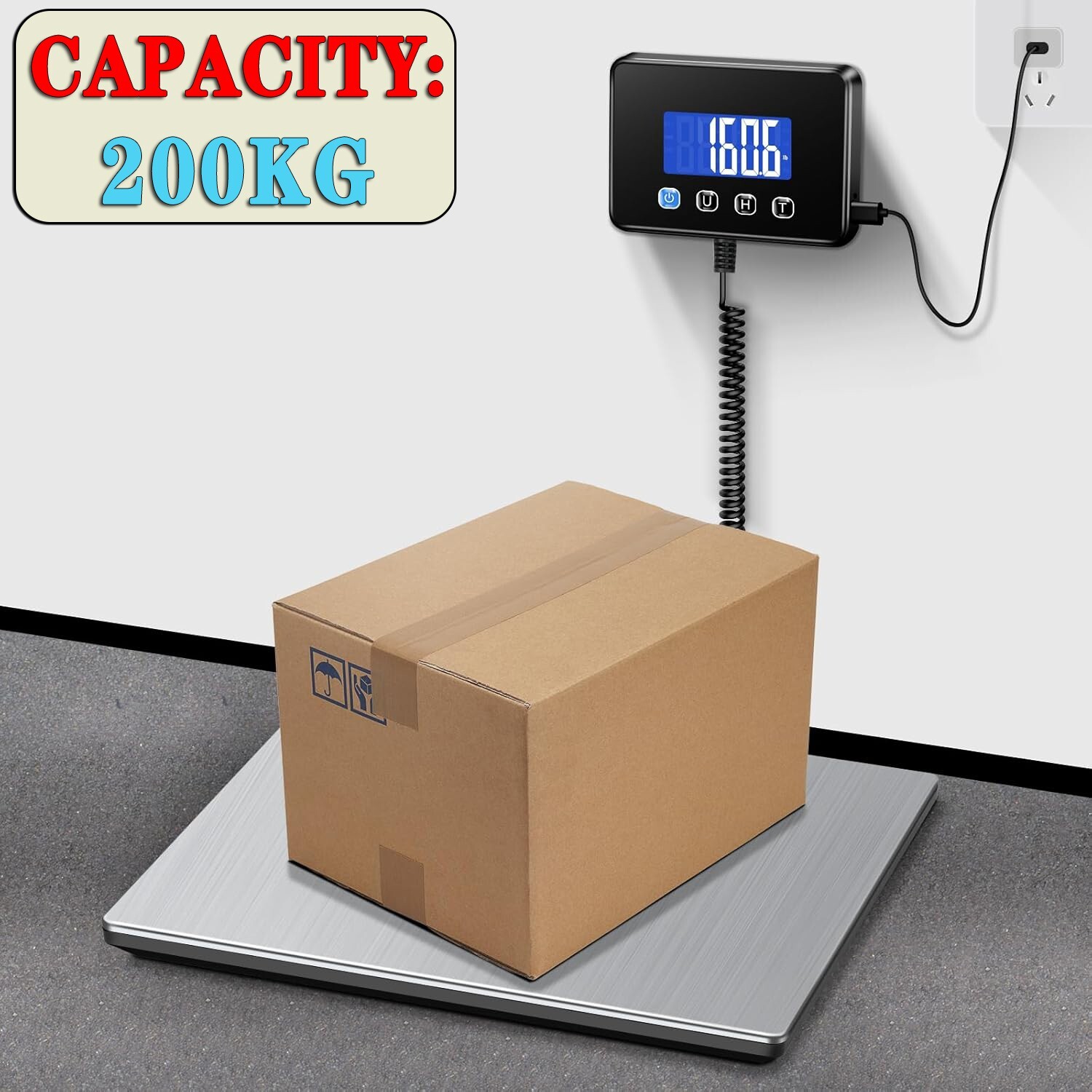

Photos from current listings. Actual item, color, and included accessories may vary.
Weighing Scale Buying Guide
Digital platform scales are flat-bed weighing devices used for shipping, postal, and industrial parcel tasks, with capacity and resolution as the core trade-off—higher capacity usually costs readability. Durable options use strain-gauge load cells with a separate display, while compromises rely on integrated electronics and thin platforms. Choose by max parcel weight and required increment: pick a platform rated at least 2x your heaviest box and a readability of 0.1 lb or finer for small parcels.
Key takeaways
- Load cell type: four-corner strain-gauge cells give stable readings; single-point cells on budget scales drift under off-center loads.
- Capacity tiers: 440 lb / 200 kg platforms are standard heavy-duty postal class; 110–330 lb models suit most e-commerce parcels but lack headroom.
- Readability: 0.1 lb (50 g) increments handle small poly mailers; 0.5 lb or 1 lb increments are only acceptable for large cartons.
At a glance
- Category
- Digital & Platform Scales
- Last updated
- Nov 29, 2026
Current offers
Highlights
- Load cell type: four-corner strain-gauge cells give stable readings; single-point cells on budget scales drift under off-center loads.
- Capacity tiers: 440 lb / 200 kg platforms are standard heavy-duty postal class; 110–330 lb models suit most e-commerce parcels but lack headroom.
- Readability: 0.1 lb (50 g) increments handle small poly mailers; 0.5 lb or 1 lb increments are only acceptable for large cartons.
- Display architecture: a tethered or wireless remote display lets you read weight on oversized boxes; integrated displays get blocked by the parcel.
Best use cases
- Best fit: home e-commerce sellers shipping 1–50 lb parcels—pick a 110–330 lb platform with 0.1 lb readability and a hold/tare function.
- Best fit: warehouse or freight desk weighing 100–400 lb cartons—choose a 440 lb / 200 kg heavy-duty platform with a remote display and AC adapter.
- Wrong fit: letter mail and small padded envelopes—skip platform scales; a 0.1 oz / 1 g letter scale is more accurate and cheaper.
- Wrong fit: weighing livestock or bulk material—skip postal platform scales; choose a cage- or bar-style agricultural scale with higher capacity.
Buying tips
- Size the platform at least 2x your heaviest parcel: a 440 lb scale covers up to 220 lb loads with headroom and better accuracy.
- Require 0.1 lb (or 50 g) resolution for parcels under 5 lb; carrier surcharges hinge on exact ounce-level rounding.
- Choose a scale with tare and hold functions—tare zeroes the container, hold locks the reading when the box blocks the display.
- Prefer scales rated for continuous AC power plus battery backup; battery-only units lose calibration and die mid-shift.
Specs
| Load Cell Type | Strain-gauge (4-corner vs single-point) |
|---|---|
| Capacity Class | 110–440 lb / 50–200 kg |
| Readability | 0.1 lb (50 g) to 1 lb (500 g) |
| Display | Integrated vs remote/tethered |
Related searches
What to check before buying
- Measure your largest box footprint: platform must exceed it by 2–3 inches on each side for stable off-center weighing.
- Confirm power: scales ship with 110V US plugs or 220V EU/UK plugs—match your outlet or use the correct adapter.
- Check surface: place the scale on a hard, level floor; carpet and uneven benches cause drift and inaccurate readings.
- Verify increment and units: scales toggle lb/kg/oz; ensure the default increment meets your carrier's rounding rules.
FAQ
Data sources: eBay / Amazon listings and product attribute feeds. Updated Nov 29, 2026.
Some links on this page are affiliate links. If you buy after clicking one, we may earn a commission at no extra cost to you. This does not change which products appear here or their order. Affiliate disclosure.