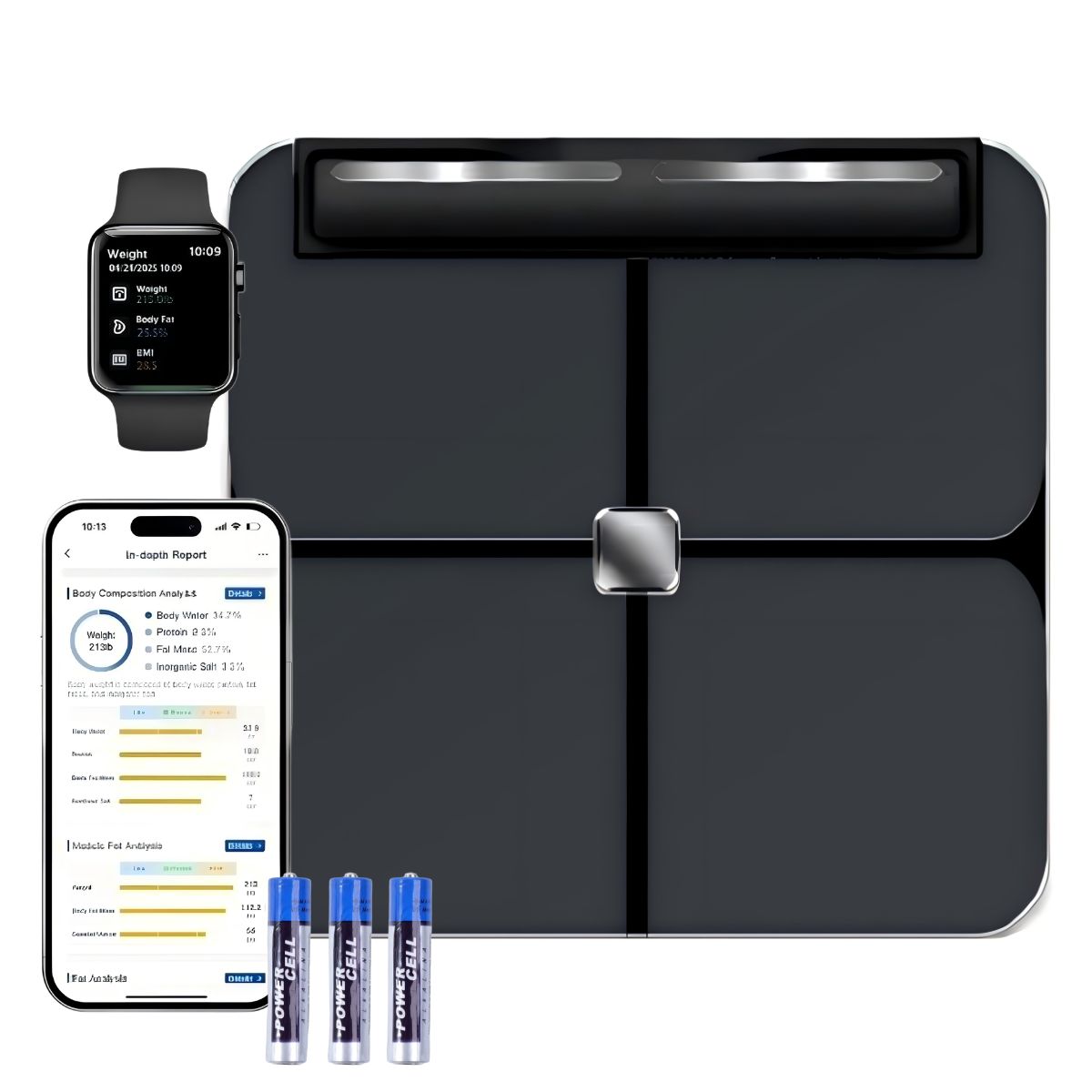

Photos from current listings. Actual item, color, and included accessories may vary.
Body Composition Scale Buying Guide
A body composition scale passes a low-voltage current through bare feet to estimate fat, muscle, and water via bioelectrical impedance (BIA), and the number of electrodes—not app marketing—decides how useful that data is. Four-electrode models read mostly lower-body impedance and derive whole-body estimates from height, sex, and age; eight-electrode designs add hand contacts to measure each limb and the trunk separately. Buy an 8-electrode scale with a companion handle if you are tracking recomposition or athletes; otherwise a well-calibrated 4-electrode glass scale is sufficient for weight and trend-level body-fat tracking.
Key takeaways
- Electrode array is the core hardware tier: 4 foot-only electrodes estimate lower-body impedance and infer whole-body fat and muscle from regression equations, while 8-electrode scales with a retractable handle measure arm, leg, and trunk segments separately.
- Load-cell construction, not the glass top, sets accuracy and life: four strain-gauge cells and a rated capacity in the 396-400 lb (180 kg) class with 0.1 lb / 0.05 kg resolution is the durable baseline; two-cell designs drift under uneven stance.
- The glass platform is a structural spec: 4 mm tempered glass is the entry standard for these footprints, while 5-6 mm tempered glass and larger platforms (around 11-12 in wide) reduce flex and edge-crack risk for heavier users.
At a glance
- Category
- Digital & Platform Scales
- Last updated
- Nov 28, 2026
Current offers
Highlights
- Electrode array is the core hardware tier: 4 foot-only electrodes estimate lower-body impedance and infer whole-body fat and muscle from regression equations, while 8-electrode scales with a retractable handle measure arm, leg, and trunk segments separately.
- Load-cell construction, not the glass top, sets accuracy and life: four strain-gauge cells and a rated capacity in the 396-400 lb (180 kg) class with 0.1 lb / 0.05 kg resolution is the durable baseline; two-cell designs drift under uneven stance.
- The glass platform is a structural spec: 4 mm tempered glass is the entry standard for these footprints, while 5-6 mm tempered glass and larger platforms (around 11-12 in wide) reduce flex and edge-crack risk for heavier users.
- Connectivity splits by generation: Bluetooth-only scales sync to a phone within range and store nothing, whereas Wi-Fi or multi-user BLE models auto-upload and auto-assign readings by profile—important for households and long-term trends.
Best use cases
- Best fit for body recomposition and lifting: an 8-electrode handle scale (Pod-style architecture) that segments arms, trunk, and legs, connected over Bluetooth to an app for trend charts.
- Best fit for a household tracking weight and approximate body fat: a 4-electrode tempered-glass Bluetooth scale with multi-user auto-recognition—skip the handle and save the complexity.
- Wrong fit for anyone wanting clinical accuracy: consumer BIA is sensitive to hydration, meals, and time of day, so for medical-grade fat measurement use DEXA or a caliper protocol instead.
- Wrong fit for a bathroom with no phone nearby: Bluetooth-only models need the app open to record; a Wi-Fi or onboard-memory scale is the right pick if you weigh in without your phone.
Buying tips
- Match capacity to the heaviest user plus margin: a 396-400 lb (180 kg) rated scale covers most adults, but users above roughly 330 lb should choose a larger platform and 5-6 mm tempered glass to avoid flex.
- Count the electrodes before trusting the metrics: 4 foot electrodes give weight plus estimate-level fat, muscle, and water; 8 electrodes with a handle are the tier that reports segmental muscle and fat.
- For households, prioritize multi-user auto-recognition and profile switching—scales that only log to one account or prompt manual selection lose data once two people step on daily.
- Confirm the app ecosystem and export: Bluetooth 5.0 with CSV/Apple Health/Google Fit export keeps years of trends usable, while closed apps with no export make the scale disposable.
Specs
| Electrode Array | 4 foot vs 8 with handle |
|---|---|
| Platform Build | 4-6 mm tempered glass, ~11-12 in |
| Capacity / Resolution | 396-400 lb, 0.1 lb / 0.05 kg |
| Connectivity | Bluetooth 5.0 / Wi-Fi multi-user |
Related searches
What to check before buying
- Measure your bathroom floor and stance: most platforms run roughly 11-12 in square, and you need about 2 ft of clear wall space for the handle cable on 8-electrode models.
- Check your phone and OS support (iOS/Android) and whether the app requires account sign-in and cloud sync before you commit to Bluetooth-only hardware.
- Plan barefoot, dry-foot use: BIA needs direct skin contact on the electrode pads, so socks, calluses, and wet tiles distort readings—weigh at the same time of day.
- Verify the scale's unit and voltage setup (lb/kg switch, battery or USB-C charging) and keep a spare battery or cable since a dying cell drifts calibration.
FAQ
Data sources: eBay / Amazon listings and product attribute feeds. Updated Nov 28, 2026.
Some links on this page are affiliate links. If you buy after clicking one, we may earn a commission at no extra cost to you. This does not change which products appear here or their order. Affiliate disclosure.