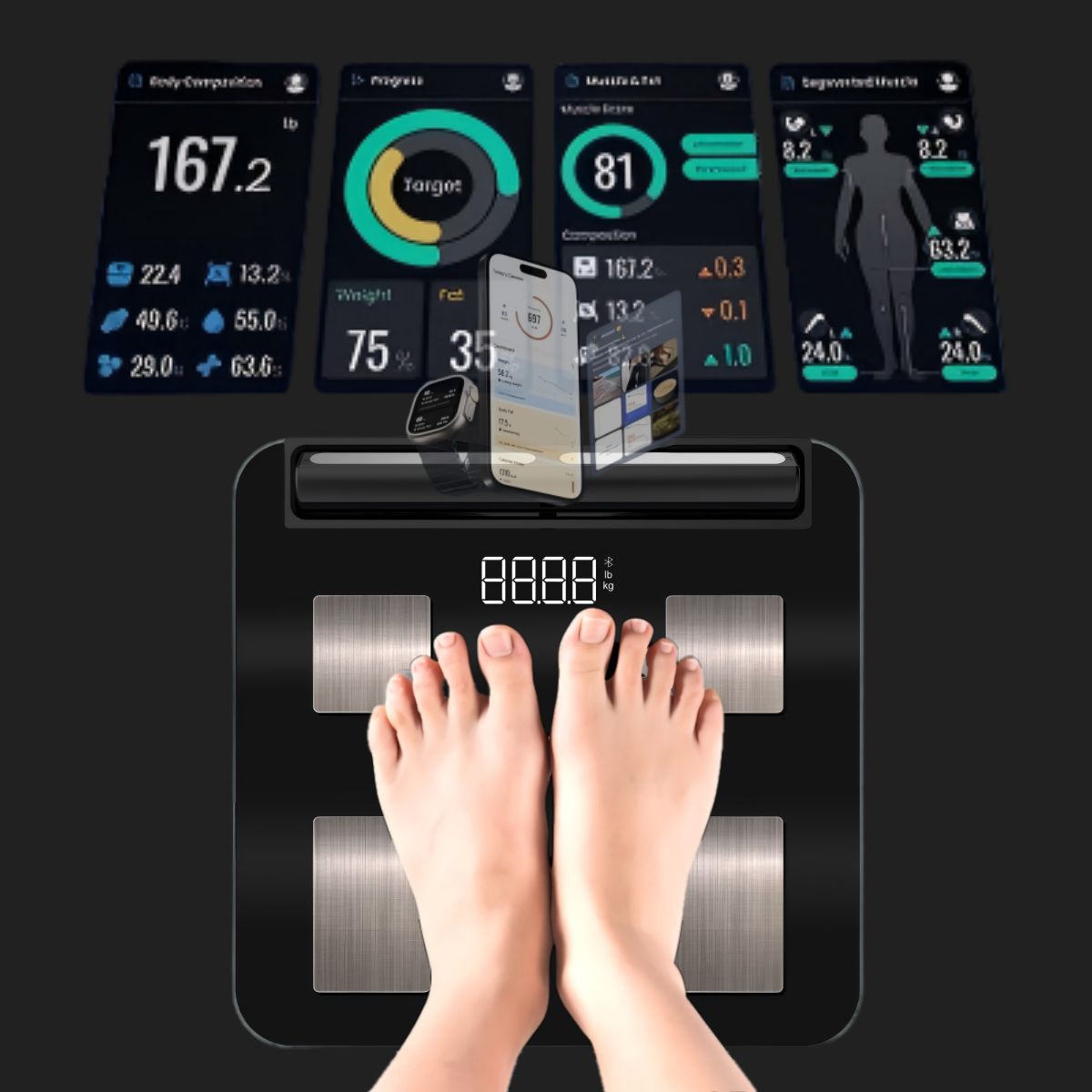

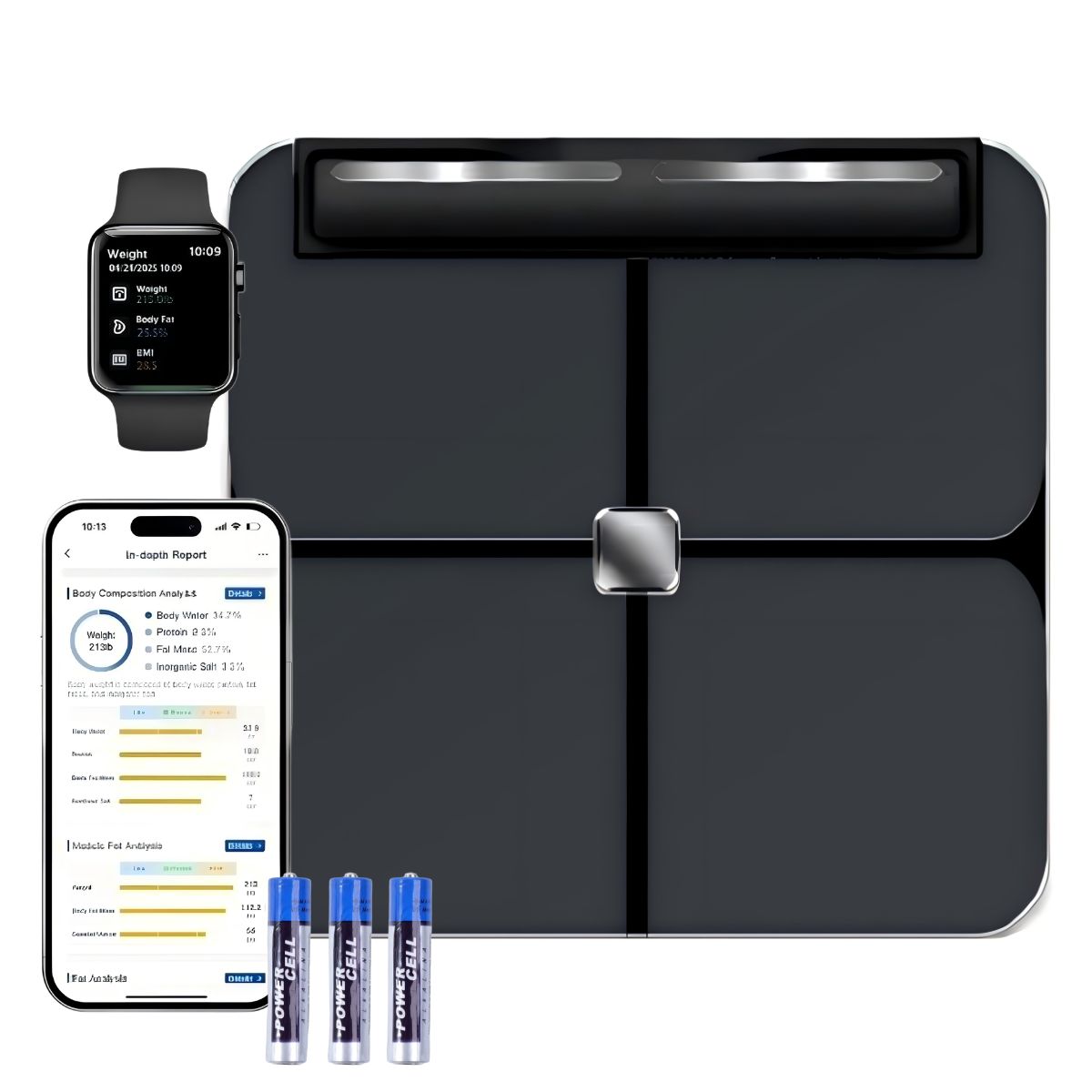
Photos from current listings. Actual item, color, and included accessories may vary.
Scale With Body Fat Buying Guide
A scale with body fat (bioelectrical impedance analysis, BIA) passes a tiny alternating current through your body to estimate fat, muscle, and water by measuring resistance. The core trade-off is electrode count and platform quality: 4-electrode foot-only scales estimate whole-body composition roughly, while 8-electrode scales with handle or foot-pad arrays segment the body into trunk and limbs for meaningfully tighter accuracy. Choose an 8-electrode, app-connected scale if you track trends seriously; choose a 4-electrode glass-platform scale only for casual weight-plus-BMI logging.
Median $162.99
Key takeaways
- Electrode architecture is the accuracy divider: 4 foot electrodes read lower-body impedance and infer the rest, while 8 electrodes (feet plus hands or segmented foot pads) measure trunk and limbs separately for segmental fat and muscle values.
- Tempered glass platforms typically run 6-8 mm thick; thinner glass flexes and can crack under heavier users, so match the platform's stated weight ceiling to the heaviest household member.
- BIA readings shift with hydration, so scales that store trend history in an app (Bluetooth sync) are more useful than single-reading displays—day-to-day noise is normal, weekly averages are signal.
At a glance
- Category
- Digital & Platform Scales
- Last updated
- Nov 28, 2026
Current offers
Highlights
- Electrode architecture is the accuracy divider: 4 foot electrodes read lower-body impedance and infer the rest, while 8 electrodes (feet plus hands or segmented foot pads) measure trunk and limbs separately for segmental fat and muscle values.
- Tempered glass platforms typically run 6-8 mm thick; thinner glass flexes and can crack under heavier users, so match the platform's stated weight ceiling to the heaviest household member.
- BIA readings shift with hydration, so scales that store trend history in an app (Bluetooth sync) are more useful than single-reading displays—day-to-day noise is normal, weekly averages are signal.
- Smart scales identify users by weight signature and route data to separate app profiles; without multi-user auto-recognition, household readings overwrite each other and corrupt trend data.
Best use cases
- Best fit: buy an 8-electrode smart scale with app trend tracking if you are cutting, bulking, or monitoring muscle mass and want segmental data you can compare week over week.
- Best fit: buy a 4-electrode tempered-glass scale with BMI and Bluetooth if you mainly want weight plus a rough body-fat percentage and prefer a slim, handle-free platform.
- Wrong fit: skip any body-fat scale if you have a pacemaker or implanted electronic device—BIA current is contraindicated; use a plain weight-only scale instead.
- Wrong fit: skip premium 8-electrode models for pure weight logging—a basic digital scale is cheaper and equally accurate for mass alone.
Buying tips
- Match the platform's weight ceiling to your heaviest user with margin: a 180 kg / 400 lb rated glass platform covers most households; budget glass often stops at 150 kg / 330 lb.
- Prioritize 8 electrodes over 4 if body-fat accuracy matters; foot-only BIA systematically misreads trunk fat, which is the most health-relevant depot.
- Confirm the app ecosystem before buying: data export (CSV/Apple Health/Google Fit) and unlimited user profiles determine long-term usefulness more than the display.
- Check graduation and units: 0.1 kg / 0.2 lb resolution with auto-calibration on a hard floor is standard; carpet use requires hard feet or a plywood base to avoid drift.
Specs
| Electrode Count | 4 foot-only vs 8 segmental |
|---|---|
| Platform Material | Tempered glass 6-8 mm |
| Weight Ceiling | 150-180 kg / 330-400 lb |
| Connectivity | Bluetooth 4.0+ with app sync |
What to check before buying
- Measure your floor space and confirm the platform footprint fits; glass platforms commonly run about 28-30 cm square and need a hard, level surface.
- Verify the weight ceiling against your heaviest household member, including pregnancy or heavy-lifting phases, with at least 10% headroom.
- Confirm smartphone OS compatibility (iOS/Android) and Bluetooth version for the app before purchase; a scale without a supported app is a dumb display.
- Check that your bathroom floor is hard and flat—tile, wood, or concrete—since carpet and uneven floors skew both weight and impedance readings.
FAQ
Data sources: eBay / Amazon listings and product attribute feeds. Updated Nov 28, 2026.
Some links on this page are affiliate links. If you buy after clicking one, we may earn a commission at no extra cost to you. This does not change which products appear here or their order. Affiliate disclosure.