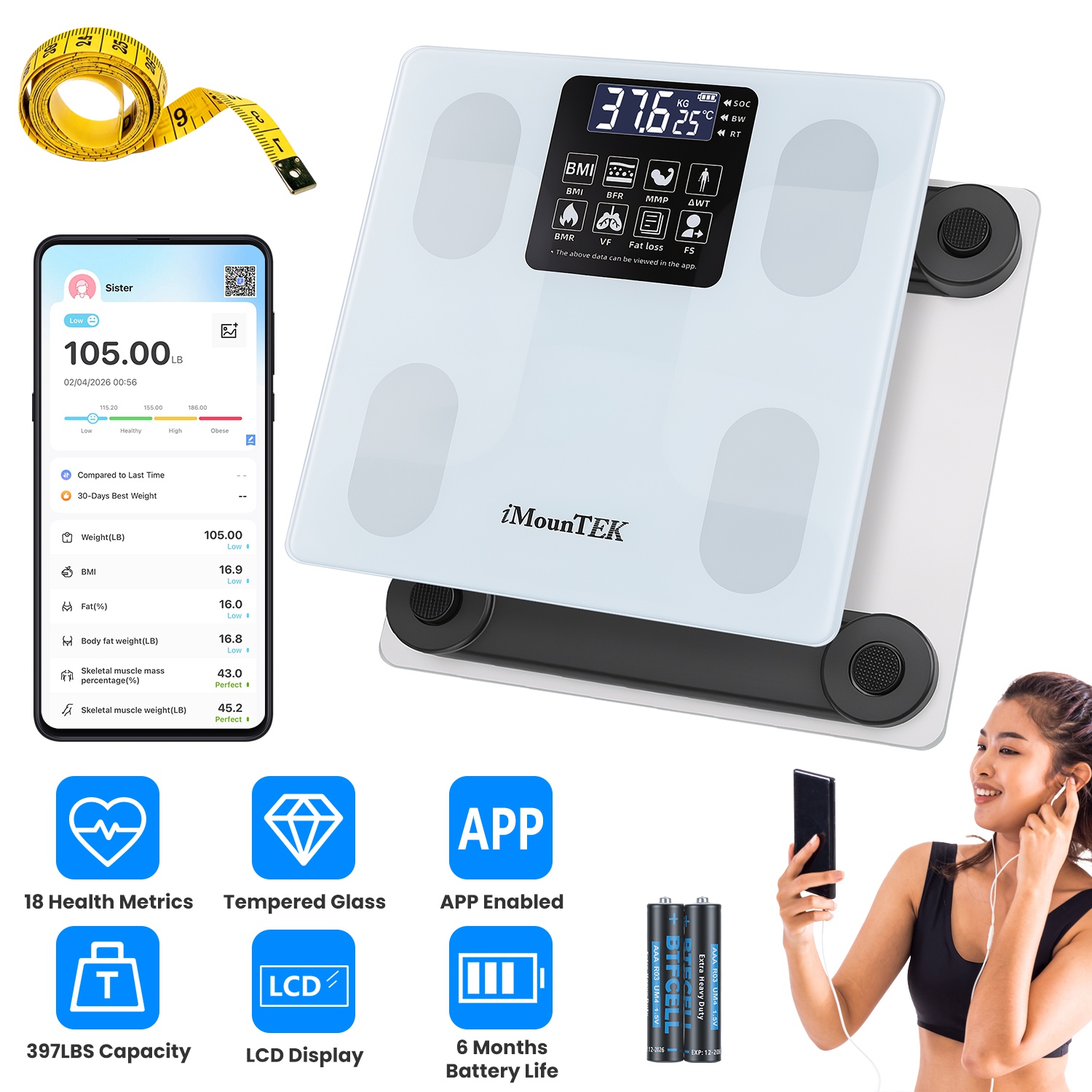

Photos from current listings. Actual item, color, and included accessories may vary.
Full Body Scale Buying Guide
A full body scale is a bathroom platform scale that measures weight (and often body composition) for a standing adult, where accuracy and durability hinge on load-cell quality, tempered-glass thickness, and surface stability. The core trade-off is between basic precision weight scales and smart composition scales whose extra metrics depend on bioimpedance electrodes and app ecosystems. Buy a basic scale if you only need repeatable weight; buy a smart composition scale only if you will use the app trend data and can stand barefoot on metal electrodes.
Key takeaways
- Load cells are the accuracy engine: four strain-gauge sensors (vs two) prevent cornering error and keep readings consistent when you stand off-center.
- Tempered safety glass at 6mm+ resists flex and cracking; 4mm glass is the budget tier and can bow under heavier users, skewing readings.
- Bioimpedance body-fat/BMI scales send a low current through bare feet; results are estimates tied to hydration and are not medical-grade DEXA.
At a glance
- Category
- Digital & Platform Scales
- Last updated
- Nov 28, 2026
Current offers
Highlights
- Load cells are the accuracy engine: four strain-gauge sensors (vs two) prevent cornering error and keep readings consistent when you stand off-center.
- Tempered safety glass at 6mm+ resists flex and cracking; 4mm glass is the budget tier and can bow under heavier users, skewing readings.
- Bioimpedance body-fat/BMI scales send a low current through bare feet; results are estimates tied to hydration and are not medical-grade DEXA.
- Smart scales sync via Bluetooth to an app (or Wi-Fi for auto-upload); basic scales show weight only on an LCD and store nothing.
Best use cases
- Best fit: a household tracking weight trends—pick a 4-load-cell tempered-glass smart scale with app sync and multi-user recognition.
- Best fit: a single user who wants no phone dependency—pick a basic digital scale with a bright LCD, auto-on, and 0.1 kg/0.2 lb resolution.
- Wrong fit: athletes wanting lab-grade body fat—skip consumer bioimpedance scales; they are trend tools, not clinical measurement.
- Wrong fit: heavy users near 400 lb—skip 4mm-glass budget models; choose a scale rated above your weight with 6mm+ glass and four sensors.
Buying tips
- Match capacity with headroom: choose a scale rated at least 10–15% above your heaviest user (e.g., 400 lb / 180 kg class for a 330 lb user).
- Prefer four load cells over two—cornering error drops and repeated weigh-ins vary less when your feet are not perfectly centered.
- For body composition, confirm stainless-steel ITO electrodes and barefoot use; socks or callused feet degrade bioimpedance readings.
- Check resolution and units: 0.1 kg / 0.2 lb increments are standard; 0.05 kg precision is unnecessary for body weight and adds noise.
Specs
| Sensor Count | 4 load cells (best) vs 2 cells |
|---|---|
| Platform Glass | 6mm+ tempered vs 4mm budget |
| Connectivity | Bluetooth/Wi-Fi smart vs LCD-only |
| Body Composition | Barefoot bioimpedance vs weight-only |
Related searches
What to check before buying
- Measure your floor space and confirm the platform footprint fits flat on hard tile or wood—carpet and rugs destabilize load cells.
- Verify your weight is under the stated capacity with margin; glass thickness and sensor count matter more than the marketing capacity number.
- For smart models, confirm your phone OS is supported by the companion app and that Bluetooth or Wi-Fi is available where the scale sits.
- Ensure the scale uses standard AAA batteries or USB-C charging you can source locally; avoid proprietary cells.
FAQ
Data sources: eBay / Amazon listings and product attribute feeds. Updated Nov 28, 2026.
Some links on this page are affiliate links. If you buy after clicking one, we may earn a commission at no extra cost to you. This does not change which products appear here or their order. Affiliate disclosure.