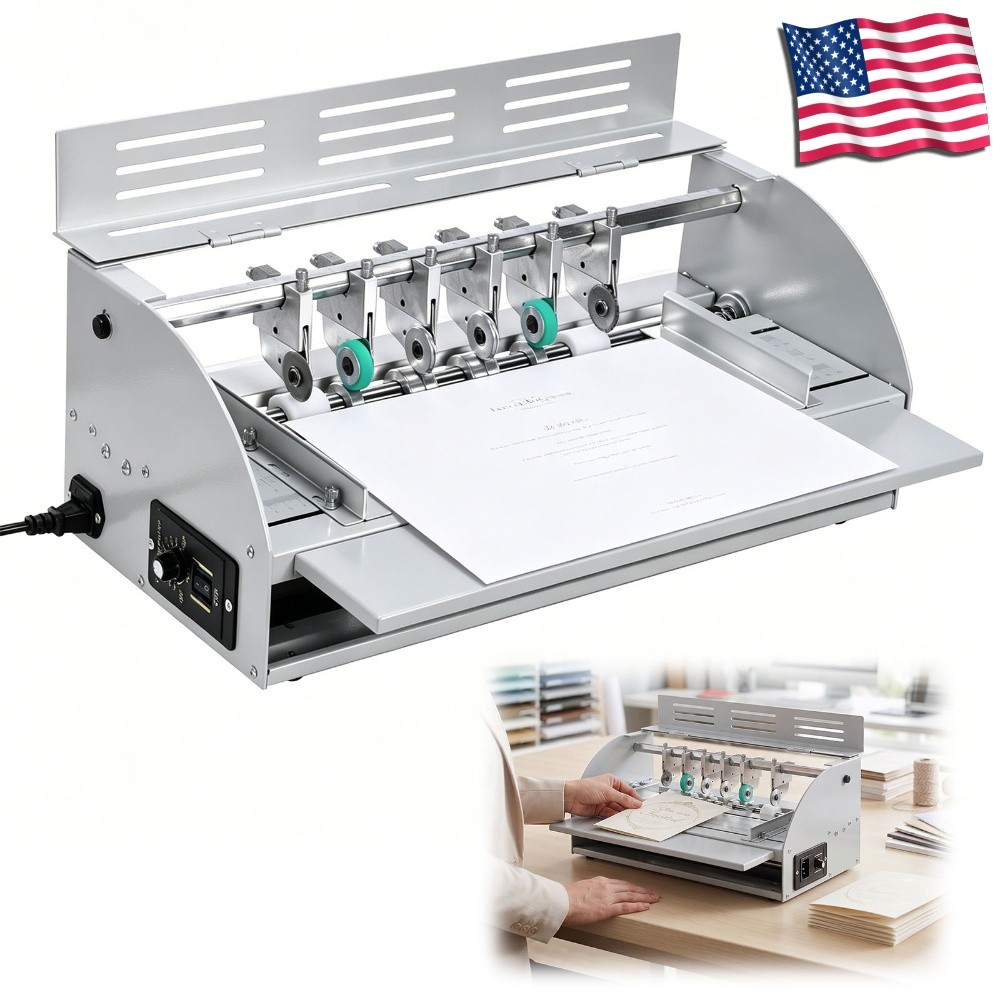

Photos from current listings. Actual item, color, and included accessories may vary.
Paper Creasing Machine Buying Guide
A paper creasing machine pre-scores heavy cardstock and coated stocks so folds are clean and crack-free, replacing manual scoring bones. The primary trade-off is manual crank vs electric feed and single-crease vs multi-function (crease/perforate/fold) architecture, which dictates throughput and stock capacity. Buy electric with adjustable speed and a pressure-adjustable crease die for production work; choose a manual bone folder or scoring board only for occasional light cardstock.
Key takeaways
- Electric models use a motorized roller with variable speed (0–100 r/min class) and foot pedal control; manual models rely on a lever or crank and are limited to low-volume bursts.
- Crease quality depends on a blunt-edged matrix die mated to a matching counter die; sharp scoring wheels cut fibers and cause fold cracking on 300–400 gsm coated stock.
- 3-in-1 architectures combine creasing, perforating, and folding via interchangeable dies; dedicated creasers run faster but cannot perforate or fold in the same pass.
At a glance
- Category
- Bindery & Print Finishing
- Last updated
- Nov 28, 2026
Current offers
Highlights
- Electric models use a motorized roller with variable speed (0–100 r/min class) and foot pedal control; manual models rely on a lever or crank and are limited to low-volume bursts.
- Crease quality depends on a blunt-edged matrix die mated to a matching counter die; sharp scoring wheels cut fibers and cause fold cracking on 300–400 gsm coated stock.
- 3-in-1 architectures combine creasing, perforating, and folding via interchangeable dies; dedicated creasers run faster but cannot perforate or fold in the same pass.
- Paper-path capacity is set by roller gap and feed table width; standard units handle 100–400 gsm, while heavy-duty models accept up to 450 gsm and sheet widths near 460 mm.
Best use cases
- Best fit: print shops and in-house marketing teams creasing 300–400 gsm coated cardstock daily — pick an electric 3-in-1 with adjustable speed and foot pedal, skip manual scoring boards.
- Best fit: small studios folding invitation suites and booklet covers — choose a manual creaser with interchangeable dies for low volume and tight budgets.
- Wrong fit: binding 80–120 gsm text paper — a creasing machine adds no value; use a folding machine or bone folder. Skip creasers for lightweight uncoated stock.
- Wrong fit: high-volume packaging runs above 450 gsm or wide-format sheets — a standard creaser will jam; specify a floor-standing heavy-duty creaser with wider feed.
Buying tips
- Match crease die to stock weight: 300–350 gsm uses a 0.5 mm crease width; 400 gsm and above needs 0.8–1.0 mm matrix to prevent fiber cracking.
- Electric models with 0–100 r/min variable speed let you slow feed for heavy covers and speed up for thin stocks; fixed-speed units risk mis-feeds on coated paper.
- Check feed width: A3 landscape folding needs at least 460 mm roller width; A4-only work fits 320–350 mm units at lower cost.
- 3-in-1 units trade crease speed for versatility — dedicated creasers run 2–3× faster per pass; buy 3-in-1 only if perforating and folding are also required.
Specs
| Drive Type | Electric motorized vs manual lever/crank |
|---|---|
| Speed Control | Variable 0–100 r/min vs fixed speed |
| Stock Capacity | 100–400 gsm standard / up to 450 gsm heavy-duty |
| Function Set | Crease-only vs 3-in-1 crease/perforate/fold |
Related searches
What to check before buying
- Measure your widest sheet flat: roller/feed width must exceed sheet width by at least 10 mm for skew-free feeding.
- Confirm stock range in gsm: standard electric creasers cover 100–400 gsm; verify your heaviest cover against the die specification.
- Check power: electric units draw 100–240 V AC; confirm plug type and circuit capacity for your region.
- Verify die availability: replacement crease matrices and perforating wheels must be orderable in your crease width before purchase.
FAQ
Data sources: eBay / Amazon listings and product attribute feeds. Updated Nov 28, 2026.
Some links on this page are affiliate links. If you buy after clicking one, we may earn a commission at no extra cost to you. This does not change which products appear here or their order. Affiliate disclosure.