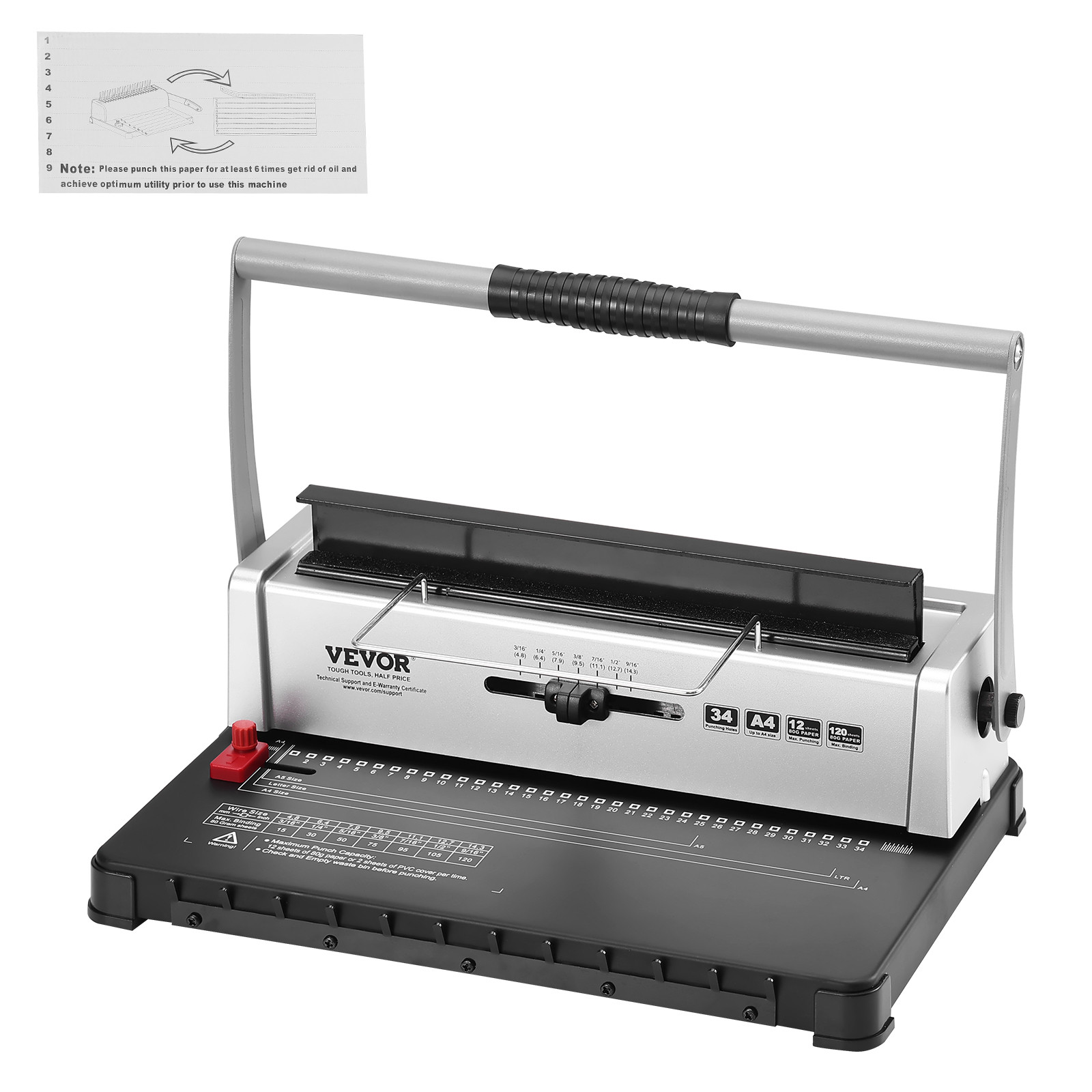

Photos from current listings. Actual item, color, and included accessories may vary.
A4 A5 Letter Buying Guide
A4, A5, and Letter are the three binding-format standards that determine whether a punch-and-bind machine can handle your documents without jams, misaligned holes, or wasted supplies. The core trade-off is fixed-die simplicity versus adjustable-die versatility: machines with a single dedicated die punch one size perfectly, while modular or multi-position dies cover A4, A5, and Letter but demand more setup care. The decision rule is simple: match the machine's punch throat and die layout to your dominant paper size, and only buy multi-format capability if you routinely switch between ISO and North American stocks.
Key takeaways
- Punch capacity is rated in sheets per lift (often 10–25 sheets for manual machines); exceeding it flexes the die and creates burred holes that tear under coil or comb tension.
- Hole pitch must match binding supply: coil uses 4:1 (0.25 in) or 5:1 (0.2 in) pitch, while comb uses 9/16 in (14.3 mm) centers—A4/Letter 3:1 wire uses 4 in pitch.
- A4 is 210×297 mm, A5 is 148×210 mm (exactly half A4), and Letter is 8.5×11 in (216×279 mm); A4 is narrower but 18 mm taller than Letter, so shared dies need adjustable side guides.
At a glance
- Category
- Bindery & Print Finishing
- Last updated
- Nov 28, 2026
Current offers
Highlights
- Punch capacity is rated in sheets per lift (often 10–25 sheets for manual machines); exceeding it flexes the die and creates burred holes that tear under coil or comb tension.
- Hole pitch must match binding supply: coil uses 4:1 (0.25 in) or 5:1 (0.2 in) pitch, while comb uses 9/16 in (14.3 mm) centers—A4/Letter 3:1 wire uses 4 in pitch.
- A4 is 210×297 mm, A5 is 148×210 mm (exactly half A4), and Letter is 8.5×11 in (216×279 mm); A4 is narrower but 18 mm taller than Letter, so shared dies need adjustable side guides.
- Manual lever machines rely on a cam and hardened steel die; electric models add a motorized punch cycle but still use the same die geometry, so format compatibility is set by the die, not the power source.
Best use cases
- Choose a fixed A4 die if your office standardizes on ISO paper and you bind reports, proposals, or manuals in A4 only—skip multi-format dies that add alignment slop.
- Choose a Letter-only die for North American client work, school packets, and legal-size-adjacent documents where 8.5×11 is the norm—do not force A4 stock through it, as the 18 mm height difference misregisters the margin.
- Choose an adjustable or interchangeable-die machine only if you regularly produce A5 booklets (half A4) alongside A4 or Letter; for A5-only volume, a dedicated A5 die gives cleaner, faster cycles.
Buying tips
- Check punch throat depth: it must exceed half your sheet length (A4: 148.5 mm, Letter: 139.7 mm) to center-punch for coil or comb binding.
- For A5 booklets, confirm the machine accepts A4 sheets for 2-up imposition or has a dedicated A5 die; punching A5 directly on an A4 die leaves unusable hole margins.
- Match binding pitch to your supply: 4:1 coil for tight 0.25 in spacing on small books, 5:1 for finer pitch and larger diameters; comb binding requires a 9/16 in pitch die.
- Manual machines are rated by lever force and sheet capacity—pick one rated at least 20% above your typical lift to avoid partial punches and die fatigue.
Specs
| Paper Formats | A4 / A5 / Letter (8.5×11 in) |
|---|---|
| Punch Capacity | 10–25 sheets per lift (manual) |
| Hole Pitch | 4:1 / 5:1 coil; 9/16 in comb |
| Die Type | Fixed vs adjustable/interchangeable |
Related searches
What to check before buying
- Measure your most common finished document size (A4 210×297 mm, A5 148×210 mm, Letter 216×279 mm) and confirm the die matches exactly—not just 'close enough'.
- Verify the punch throat depth clears half the sheet length so holes land centered for coil, comb, or wire binding.
- Confirm the die's hole pitch (4:1, 5:1, or 9/16 in) matches the coils, combs, or wire spines you will buy.
- Check bench space and clamping: manual punch machines need clearance for the lever arc and a stable surface for consistent margin alignment.
FAQ
Data sources: eBay / Amazon listings and product attribute feeds. Updated Nov 28, 2026.
Some links on this page are affiliate links. If you buy after clicking one, we may earn a commission at no extra cost to you. This does not change which products appear here or their order. Affiliate disclosure.