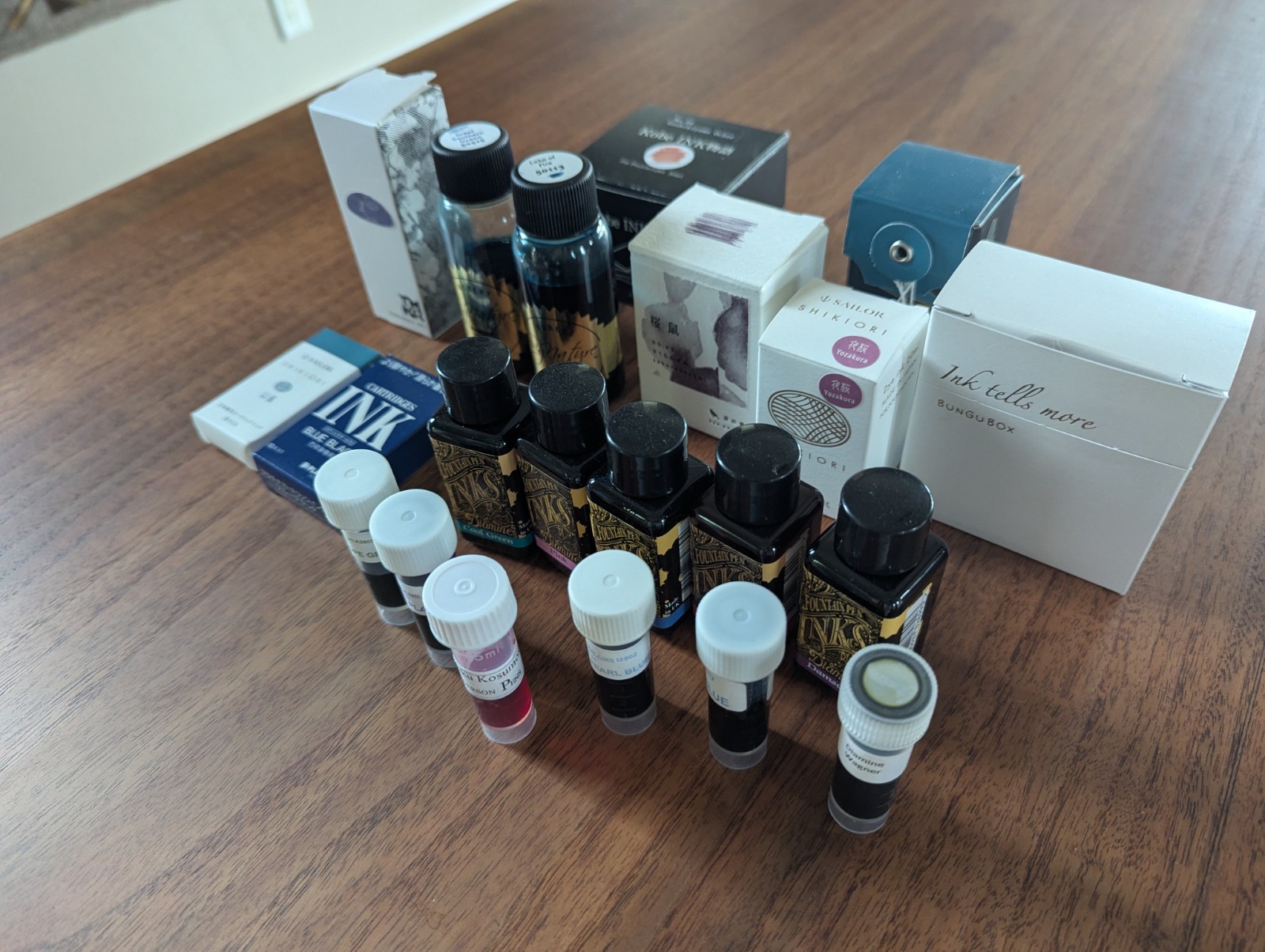

Photos from current listings. Actual item, color, and included accessories may vary.
Pilot Fountain Pen Ink Buying Guide
Pilot fountain pen ink splits into two distinct chemistry families: the dye-based, lubricated Iroshizuku line (bottled in Japan) and the pigment-based Pilot pigment inks, with the primary trade-off being flow/ease-of-cleaning vs. water resistance and permanence. The clear decision rule: buy Iroshizuku for daily writing, shading, and low-maintenance color variety; buy pigment ink only when documents must survive water exposure and you accept stricter pen hygiene.
Key takeaways
- Iroshizuku is a dye-based, pH-neutral ink formulated for low feathering and high shading; it is not waterproof and will lift with water.
- Pilot pigment inks (e.g., Namiki/Pilot pigment series) suspend solid color particles that bond to paper for water resistance but require more frequent flushing.
- Iroshizuku bottles come in 15 ml, 30 ml, and 50 ml sizes; the 50 ml faceted bottle is the standard full-size, while 15 ml minis are sampler-grade.
At a glance
- Category
- Fountain Pen Inks
- Last updated
- Nov 29, 2026
Current offers
Highlights
- Iroshizuku is a dye-based, pH-neutral ink formulated for low feathering and high shading; it is not waterproof and will lift with water.
- Pilot pigment inks (e.g., Namiki/Pilot pigment series) suspend solid color particles that bond to paper for water resistance but require more frequent flushing.
- Iroshizuku bottles come in 15 ml, 30 ml, and 50 ml sizes; the 50 ml faceted bottle is the standard full-size, while 15 ml minis are sampler-grade.
- Dye inks flow readily in fine nibs (F/EF) without clogging; pigment inks demand wider flow channels and should be avoided in very fine or vintage nibs.
Best use cases
- Best fit: Daily journaling, note-taking, and letter writing in standard converters or cartridges — pick Iroshizuku in a 50 ml bottle for cost-per-ml efficiency and broad shading.
- Best fit: Testing colors before committing — pick the 4 ml sample set or 15 ml minis to evaluate dry time, feathering, and color on your paper.
- Wrong fit: Signing legal documents or addressing envelopes exposed to rain — skip dye Iroshizuku; choose a pigment or iron-gall document ink instead.
- Wrong fit: Vintage or very wet-writing flex pens — avoid high-saturation pigment inks; stick to Iroshizuku or other low-pigment dye inks to prevent feed clogging.
Buying tips
- Match bottle size to usage: 15 ml mini yields roughly 25-35 converter fills; 50 ml yields roughly 80-110 fills — buy 50 ml once a color proves itself.
- Check nib compatibility: dye Iroshizuku suits EF through B nibs; pigment inks perform best in M/B and should not go into nibs finer than F without daily writing.
- Prefer glass bottles with tight phenolic caps for long-term storage; sample vials are best decanted into a converter within weeks to avoid evaporation.
- For water resistance, verify the label says 'pigment' or 'document' ink — standard Iroshizuku colors (e.g., Kon-peki, Tsuki-yo) are water-soluble by design.
Specs
| Ink Chemistry | Dye-based vs pigment-based |
|---|---|
| Water Resistance | Dye: none / Pigment: high |
| Bottle Sizes | 15 ml / 30 ml / 50 ml |
| Nib Compatibility | Dye: EF-B / Pigment: F-B |
Related searches
What to check before buying
- Confirm your pen accepts standard international or Pilot proprietary cartridges/converters — Pilot pens use proprietary Pilot cartridges, not international standard.
- Measure storage: 50 ml Iroshizuku bottles are roughly 6 cm wide and 8 cm tall; ensure your ink drawer or pen case accommodates the faceted glass base.
- Check climate: store inks below 30°C and out of direct sun; dye inks are stable for years, but repeated freeze-thaw cycles can alter pigment suspension.
- Have pen flush or distilled water on hand — pigment inks need thorough flushing between fills, and hard tap water can leave mineral deposits in feeds.
FAQ
Data sources: eBay / Amazon listings and product attribute feeds. Updated Nov 29, 2026.
Some links on this page are affiliate links. If you buy after clicking one, we may earn a commission at no extra cost to you. This does not change which products appear here or their order. Affiliate disclosure.