Do Open-Plan Offices Really Boost Collaboration? A Myth-vs-Fact Look
Open-plan offices are often described as collaboration boosters, yet field studies suggest they can cut face-to-face conversation and privacy. Here is what the evidence actually supports.
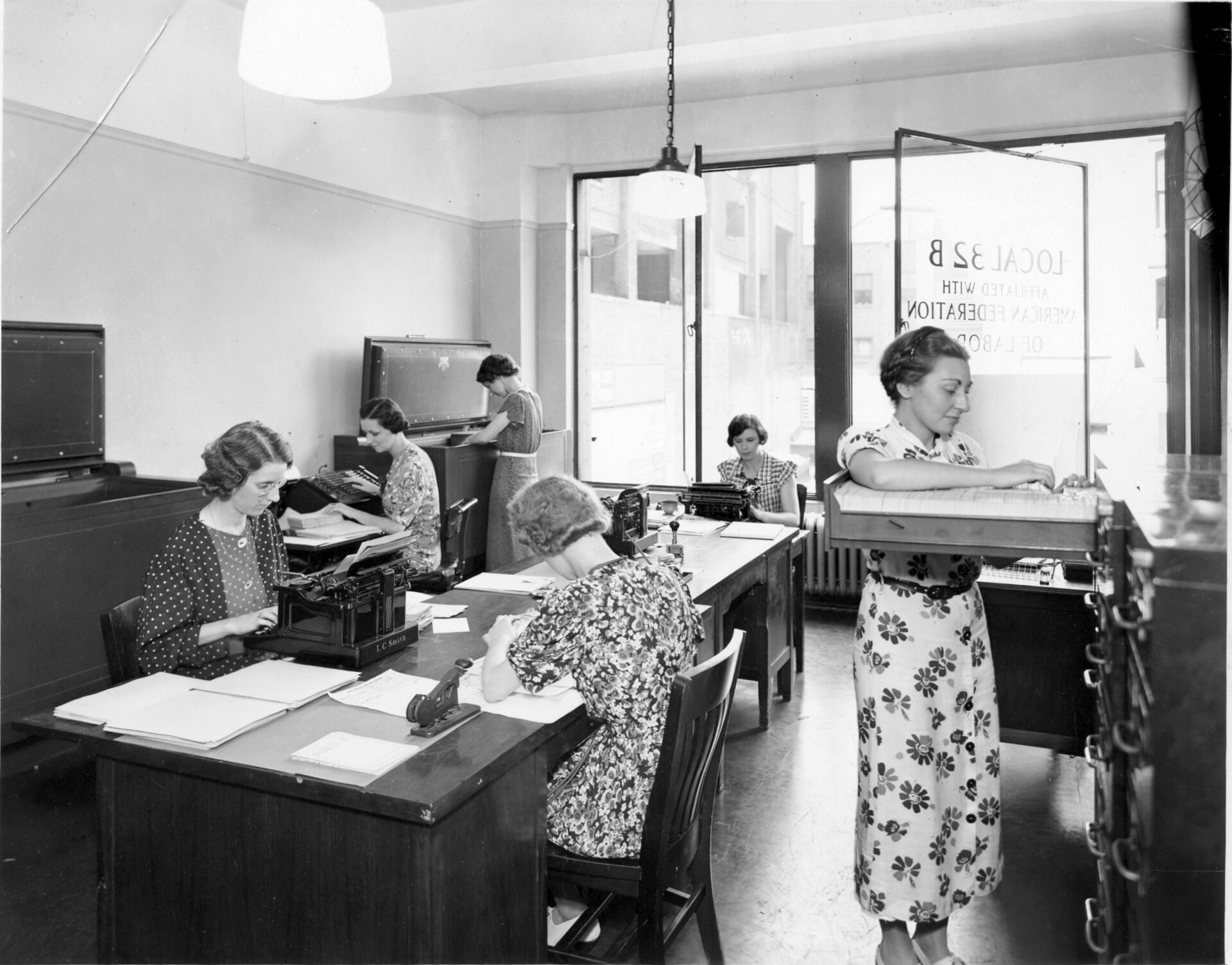
Cover: SEIU 32BJ Archives · Wikimedia Commons · Public domain
Question: Do open-plan offices really improve collaboration and productivity, or is that mostly a myth?
The myth, stated plainly
The familiar story goes like this: knock down the walls, put everyone on one floor, and ideas will collide into innovation. Low partitions are said to encourage spontaneous conversation, speed up decisions, and make teams feel more connected. It is an appealing picture, and it is the reasoning behind decades of office redesigns. The trouble is that the claim is usually stated as a slogan rather than a tested finding, and the studies that have actually measured what happens tell a more complicated story.
What field research found on conversation
One widely cited study tracked two companies moving from cubicles into open-plan layouts by analyzing email and instant-message traffic alongside in-person interaction. Rather than rising, face-to-face interaction dropped sharply after the move, while electronic messaging increased. The authors suggested that open layouts may push people toward screens for the conversations they previously had across a desk, because the space offers little privacy for a candid chat. That finding is a challenge to the assumption that proximity automatically produces conversation.
What field research found on satisfaction
A large survey of tens of thousands of office workers in the United States examined how layout related to satisfaction. People in open-plan settings reported less satisfaction with privacy and with the workspace overall than people in enclosed or partitioned spaces, and higher partitions were associated with better ratings on those measures. A separate longitudinal study of government employees who relocated from private rooms into an open-plan floor reported more distraction from noise and reduced satisfaction with the environment after the move. These are self-reported outcomes, not direct measures of output, which matters for how strongly the results should be read.
Fact: layout is a trade-off, not a switch
The evidence does not support a clean claim that open offices are either good or bad. It supports a trade-off. Removing walls can make casual exchange easier and can reduce the cost of fitting more people into a floor, but it also lowers acoustic and visual privacy, and those losses carry their own costs in concentration and satisfaction. Research on workspace satisfaction consistently frames the issue as a privacy-communication trade-off rather than a single lever that raises performance.
Why the myth survives anyway
Layout changes are easy to photograph and easy to describe in a presentation, while the effects on concentration and conversation are slow, uneven, and hard to attribute to any one cause. Open planning also has a long design history, from mid-century office-landscape concepts to modular furniture systems that were later used to build ever-denser cubicle farms. Each generation inherited the promise while the measurement lagged behind. Add that teams rarely run a before-and-after study of their own, and the slogan outlives the evidence.
A more useful way to ask the question
Instead of asking whether open plan works, ask what a given team does all day. Work that depends on frequent, short exchanges has different spatial needs from work that depends on sustained concentration. Practical responses include a mix of settings rather than one universal floor plan, quiet zones with real acoustic separation, small enclosed rooms for sensitive conversations, and the option to move for a focused block of time. These are design choices to be tested locally, not guarantees, and any workplace change is worth reviewing with the people who use the space.